Showing posts with label crime. Show all posts

29 October 2020

Reviews Part Two


For years, my first Jenny Parker novel struggled to get reviews. There were a fair number of sales, but reviews were hard to come by. Then I wrote the blog previous to this one.

Unbeknown to me, my publishers had created a big promotion for the Jenny Parker series around the same time.

Normally, my sales are communicated to me with my royalty statement on a six monthly basis. A very good half-year might involve a thousand sales. I'd not had a good one for quite a long time. We're talking a few dozen sales.

I went to an old friend's farm to give him my rescue chickens. This isn't a digression, though it might sound like me going off at a tangent, because his partner and her friend have been keen readers of my books for years. A socially distanced chat revealed that she hadn't read the latest Jenny Parker book and she rang her friend to tell her there was another treat coming her way. I offered to send her a copy but she said she was happy to buy one.

OK, I'm getting to the point. Be patient.

If I want to see how my books are doing, I go to my Amazon author's page and look at the charts. One sale makes a big difference when you're selling very few books. You can soar from number 1,000,000 to number 50,000 in an instant before gradually decaying back down to earth.

On a promise of a sale, I checked my Amazon page. All my books were doing ridiculously well. Due Diligence was second overall in the UK and 3rd overall in the US. Obviously there was a glitch with the figures so I checked with my publishers. No glitch, more than 30,000 downloads, they said.

I was gobsmacked and happy. Then the sales persisted. Then the reviews and ratings began to accumulate. DD has well over a hundred positive reviews now.

So, I'm telling you that writers should never give up. Success can come at any time. And when it does, I have to remind myself to taste the sweetness instead of wishing for even more.

One sale is enough to make me happy. One positive review increases that happiness tenfold.

Despite the pandemic, there's a big smile on my face most of the time now.


3 April 2019

Precious Words


People ask me how many words they have to write before they have a novel. It's an interesting question. Writers like me can be a bit obsessive when it comes to word count. I use it as a measure of progress. I like to write at least a thousand words every day. My problem is letting some of them go into the trash but I'll come to that later.

I'm reminded of the story about the budding author who approaches a publisher at a party. 'What's the least number of pages you'd publish as a novel?' she asked. 'Three hundred,' he answered. The writer threw up her hands in joy and went running excitedly around the room shouting 'It's finished!'

The conventional answer to the question is seventy to ninety thousand words though some genres like fantasy can be much longer. I would add a few words of caution, though. The important thing is to tell the story in a compelling way. That may take more words or, preferably, fewer. Vonnegut urged us to 'start as close to the end as possible'.

Which brings me back to the unpalatable truth that not every word I write is either necessary or appropriate for the story I'm telling. Accepting this isn't easy. Those words were painstakingly and often painfully extracted. Losing them into the oblivion of the trash bin can hurt.
There are times when I read through the previous day's output and am tempted to trash the lot. This is normal but ill-advised. I have learned to leave everything exactly as it was written until I've finished the story. Then, after a period of reflection, revision can take place.
Working with an editor has taught me that I am not a good judge of my own work.

The initial casualties of the editing tend to be the first few chapters. Often these can be completely removed with great benefit to the whole piece. Why is that? The way I've come to think about this is to consider the opening exchanges of a difficult conversation. Imagine having to persuade someone to do something you know they won't like. How would you start the conversation? I'd certainly not go straight to the point. I'd ask them how they were and try to get an idea of how they were feeling. See if there was some angle I could use to soften the impact of the harsh words to follow. So it is with my characters. They are inevitably in for a hard time. I'm about to throw all kinds of trials and tribulations their way. Before I do, though, I spend a bit of time getting to know them a bit better.
The reader doesn't have to see this process.

My first Jenny Parker novel originally began with a long detailed scene with Jenny sitting on a toilet. I resisted its deletion with all my might but eventually conceded that this piece of information might have been essential for me but it was something my readers should be spared.
Incidentally, six years after its first publication, a new edition of Due Diligence has been released. The toilet scene is still missing.

21 October 2018

Unruly Chracters


As you might already be aware, I try to write a bit every day. I wake up in the morning and find myself enveloped in the story. I look around and see the characters who then begin to do things. Sometimes unexpected things. Unintentioned things. Exciting things. That's what makes writing so interesting for me. It's the not knowing.

When I get almost to the end of a story and realise what's going to happen, it becomes more of a struggle to write. It's as if my mind has finished with the project and is no longer interested.

I have been a little bit poorly of late and unable to write. Now I'm recovered and back at it, I find that my characters haven't had the patience and good grace to hang around and wait for me. Instead, they seem to have carried on regardless and what was a nice linear plot line involving four of them in a voyage of discovery has fallen to bits. I left them all on a perfectly good ship complete with crew, provisions and a clear plan. On my return, I find the ship is gone. I have no idea where it is. One of my characters is sitting on the shore feeling sorry for himself. Two more are wandering around in a jungle when they should be on the ship. These are the least of my problems. My fourth character has disappeared completely.

You might think it would be easy to find her. I'm the writer, after all. The fantasy world I've created is a bit short of detail, though. I only know about the places my characters have actually been. She may have gone somewhere new. Or even hopped out of this particular version of reality into a completely different one. She can do things like that. She's a witch.

OK, I'm currently writing fantasy but my process is the same for my crime thrillers. I'm with the reader all the way. I know what they know. I can speculate, just as they can, and I do this in the same way whether I'm writing or reading someone else's story.

Another thing I should mention is that my characters appear fully formed. What I mean is they have lived their lives outside the confines of my story and their motivation derives from experiences I have no knowledge of. Usually, I get to understand them better as the story unfolds. That's what makes them interesting.

Like my witch. After 250,000 words of the story, I'm at last beginning to understand the reasons behind her behaviour right at the beginning. What she did then is only now beginning to make sense.

Are writers supposed to carefully design characters down the the colour of their eyes and the toys they received for their first Christmas? Should they always know what's going to happen at the end of their story? 

Am I the only one who writes without knowing anything?


photo credit: Jrwn Photography Natcha via photopin (license)

29 July 2018

Violence


I love a good thriller and thrillers usually involve violence. What I don't like is the portrayal of violence as the universal answer to any problem. If I read a book or watch a film that uses violence to sort the job out, I feel cheated. I think of it as lazy and unimaginative writing.
Violence creates problems, it doesn't solve them.
Take a comment I once saw posted on the Glock website. (For those of you who don't have an interest in handguns, I will explain. Glock make pistols that are the weapon of choice for many law enforcement agencies. British police use them, for example.) A customer asked why the Glock 19 only held fifteen bullets in its magazine. The answer was a good one. If fifteen rounds from a Glock hasn't solved your problem then maybe you chose the wrong solution.
My complaint is that books and films choose the Glock solution too often when it is inappropriate and unsatisfactory.
Most of us don't have the option to visit violent retribution on evildoers. As any sane American will testify, nor does having a gun protect you. (Unless someone shoots you and the bullet hits your gun and bounces off, I suppose)
My protagonist in Due Diligence, Jenny Parker, is an ordinary person. She's just like you and I. Vulnerable. No institution to back her up. She doesn't have the option to fight fire with fire. That would not only get her arrested. It would be also be pointless and ineffective. She has to find other ways to survive. She has to use her wits.
I find that so much more satisfying to write and to read.
As for the magazine capacity of a Glock 19, I find it hard to stuff more than ten rounds into the magazine before the spring gets too stiff for my thumb.
(I hasten to add that my experience of handguns has been limited to a legal range in the US while conducting research. Sometimes it's necessary to obtain first hand experience even if you disapprove of what you're trying out.)


photo credit: subtlemd CZ 85B 9mm via photopin (license)

26 March 2018

Nowt on Telly


If you're like me, you've spent a fair amount of time watching things on TV that, in hindsight, seem a complete waste of time. Then you watch the next instalment if only to see if this one's any better than the last. Perhaps, as I have, you've become inexplicably hooked by a couple with more money than sense being filmed looking for a property in the country.
If I see one more undercooked rack of lamb on Masterchef I may throw up.
There's an antidote to the hollow feeling that comes from wasting an evening in front of the box. It might be hard to swallow for the first few attempts but it's well worth persevering. If you do, a whole new richness will enter your life. Every day will hold the promise of discovery and excitement. Life will feel that much more worthwhile.
There's a magical effect produced when a TV is switched off. Your attention becomes your property again. You can do with it whatever you wish without it being constantly dragged to the screen.
Then there's the silence. Opportunity for stillness. Your mind relaxes, free from a constant bombardment of images and sounds.
So what do you do instead? What's this magical alternative to relaxing in front of the telly?
Read a book.
It's the best antidote to boredom and that empty feeling of having wasted time.
Ok, I'm an author so I would say that, you might think. There he goes, trying to peddle his books, you might say.
In response, I admit that I'm as affected by TV in all its forms as anyone. I waste vast amounts of precious time slumped on a sofa in a semi-comatose state.
As soon as I pick up a book and start reading, I feel so much better. Reading is a much richer experience than TV can ever be.
I'll prove it to you, if you have any doubts. Read any book that has been adapted for TV, then watch the program or film. It's become a cliche that the book is always better than the film but this just isn't fair. A book is a book and a film is a film. They're different media. You can do things in books that films, even using the most sophisticated computer generated imagery, can't possibly display. The greatest actor on the planet can't hope to communicate feelings with the same intensity that living inside the character's head can.
Try Lord of the Rings, even if you've seen all the films.
Read The Handmaid's Tale, even if you saw the TV programme.
Read The Shining, then watch the film.
Read anything by Iain Banks, David Mitchell, Haruki Murakami, Neal Stephenson.
Why not try the greatest crime writer in the history of the world, Raymond Chandler? His books have been made into films again and again. The Big Sleep is a particular favourite of mine.
You don't even have to buy a book. We have a brilliant library service in Lancashire.
If you do want to make a purchase, support an independent book shop.
By the way, there's a TV adaptation of China Mieville's The City and the City coming on the BBC. Get the book. Immerse yourself. Then enjoy the program in a very different way.

20 February 2018

Freefall Writing


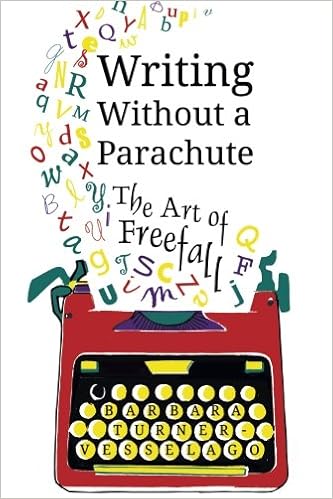
https://www.amazon.co.uk/Writing-Without-Parachute-Barbara-Turner-Vesselago/dp/1785921711/

No matter how long I've been writing, there's always more for me to learn. Reading other writer's work is a brilliant way to do that. Writing itself, just putting words on paper is also recommended. However, a school teacher once told me that practice did NOT make perfect. 'If you carry on making the same basic errors, you'll never improve. CORRECT PRACTICE makes perfect' is how he expressed it.
With that in mind, though they say you shouldn't take any notice of school teachers because 'those who can, do and those that can't, teach,' I try to take every opportunity to improve my writing technique.
Content isn't a problem for me. I'm blessed with a very inventive mind that is harder to rein back than it is to get going. Getting it down on paper in a manner that will keep a reader engeged is the trick as far as I'm concerned.
Many years ago, I was introduced to Barbara Turner-Vessalago's Freefall writing method and I've been attending her two UK workshops every year since.
My first attempts at novel writing are the stuff of legend. I wrote a SF trilogy with a casual, stand-offish point of view that was packed with self-conscious humour that didn't work and served only to dissipate what little dramatic tension I'd created.
Barbara taught me to write from a more authentic place. To embody what I was saying. To feel in to the characters and the situation. To drop into a place, look around, see what was happening, smell the air, listen to the wind in the trees, watch my characters react to their surroundings.
Her workshops are wonderfully transformative. She is a supremely gifted mentor and the feedback she gives is always exactly what is needed. Unfortunately, there are only two courses per year in the UK and only twelve writers per workshop. Of the twenty four potential places, though, at least half are taken up by gluttons like myself. So the opportunities to attend are very limited. If you ever get a chance, I advise you to take it because you won't regret it.
After much heart-searching, Barbara distilled her teaching into a book which provides a very cost-effective alternative to her workshops and is the next best thing.
With Barbara's blessing, I'm going to be giving a short introductory workshop to Chorley and District Writers' Circle on February 27th. Check out  http://www.chorleywriters.org.uk/ if you're interested.
If you can't make it, get the book.

17 July 2017

Is Kindle broken?


Amazon KDP has been good to me. Way back in 2013, Due Diligence made it into the top twenty crime thrillers and the overall top one hundred kindle charts. You can imagine how chuffed I was. I sold several thousand books in a very short time and all because Stephen Leather invited his readership to try it.

A few years down the line, services like BooksgoSocial and Bookbub will promote your book for a modest fee. They can be picky, though, as they depend on keeping faith with their readers and not fobbing off some rubbish on them. A lot like Stephen, who took the trouble to read the copy I sent him. Not like Stephen because he helped me for free, as he's helped lots of other writers.

Amazon, in order to promote their Prime membership, decided to offer free loans of books that were enrolled in KDP Select. At first they paid authors on the basis of downloads. Then they decided that this wasn't fair. Short books received the same payment as longer ones. It didn't matter if the books were read or not the author got paid regardless. Then Amazon decided to change the basis of payment. Every page read was recorded and totted up and the fund distributed accordingly. Seemed fair to most people at the time.

I quite liked it at first, I had a 'pages read' graph to go with my copies sold one. Some days, I'd pretend the pages read were the copies sold just to make me feel especially good. Then bad things started to happen. I got wind of authors' amazon accounts being removed because of anomalies in their page counts. One of my books took a leap skywards for no reason, thousands of page reads where there had been a steady few hundred before. I got cold feet and took all my books off Select. Losing your Amazon account is fatal for an author in these digital times and I realised that abuse of the new Amazon payment system was likely to become worse. I was right.

Recently, really awful books by unknown authors have been hitting the top of the Kindle charts. Books with very few and very bad reviews. They got their exposure and thousands of sales by what's known as clickfarming.

Clickfarming involves downloading the book hundreds of times and then employing someone to flick through each copy. Let's say a book is 200 pages. After each 200 page views are recorded, Amazon count it as a sale. Then the book is catapulted up the charts, people see it and they buy it.

Not only that, but the author is paid a share of the KU pot on the basis of every page read.

Some organisations offer this service to authors for a fee. Others take all the money themselves by uploading their own books, often computer generated or pirated.

In order to make it more difficult for Amazon to detect them, some clickfarms add some 'innocent' books to the ones they are pushing.

Amazon delete the accounts of anyone they suspect of clickfarming and this seems to have included authors who were completely unaware of what was going on. I've not heard of any successful appeals.

So, keep your eyes peeled, stay sharp and safeguard your precious account. If you're new to Kindle, think twice before enrolling in Select.


photo credit: ToGa Wanderings Free Internet via photopin (license)

10 April 2017

Don't Give Up


William Shakespeare was not impressed when we met.

Me? I'm trying to put on a brave face in front of the diminutive literary giant and failing badly.

It's easy for a writer like me to fall into the trap of becoming overwhelmed by a feeling of inadequacy when confronted by someone I can't ever hope to emulate. I've often felt like giving up writing after reading Iain Banks or Haruki Murakami. I can't write like they do so why should I bother trying?

A couple of people in my writers' circle have recently informed me that they are giving up writing. They both cited disappointment with their lack of success with books they had published. This has got me thinking about my own situation. The odds are stacked against me becoming a literary giant.

So why bother writing at all? It's hard work, demands a lot of time and produces scant monetary reward. Putting in the same hours at work would make much more economic sense.

These are some of the thoughts I've had:

Writing is like golf.

I don't play golf regularly. I've never been tempted to take it up but I have played a few rounds in my time. If I did play golf I would do it without the expectation of winning the British Open. So why expect to win the Booker Prize with my writing?

What would I do someone saw me playing golf and said that I could earn as much money as Tiger Woods and if I gave them a few thousand pounds they would show me how? Laugh in their face, of course. But what about those predatory publisher that make similar promises? What is it that makes us writers so vulnerable?

If I did play golf I wouldn't expect friends and family to spend hour after hour trudging around after me watching me hack my way from hole to hole. So why do I expect them to drop everything and read whatever I write as soon as I send it to them?

Then there's the issue of practice. If I want my golf to improve I need to take lessons, which I have to pay for. OK, I might get some help from a playing partner who could make a few observations about my technique, or lack of it. Another golfer may be able to spot some obvious flaws but if I'm to remedy them I'll need professional help. Writing is very much the same. If I keep on writing the same way for year after year there's not going to be much improvement. Other writers might point out that I'm telling rather than showing, or that my characters are stereotyped but I'm going to need to attend some courses or get some coaching if I'm going to change things. Practice is essential, but it needs to be informed. The right kind of feedback is essential for progression.

Very few get to be professional golfers. It's the same with writers. Yet golfers keep on golfing, they don't give up just because the hurdle to fame and fortune is set unreasonably high. They play because now and again they hit an almost perfect shot and that gives them immense satisfaction. Nobody else needs to see their hole in one, though it's even more fun if they do. Sometimes I write something that makes me sigh with pleasure or laugh out loud. That's why I write. If it makes someone else feel the same way, then even better.

My advice is this. Write. That's what writers do. Commercial success is an unrealistic expectation forced on us by a society that demands instant gratification.


4 December 2016

Reviews


This isn't a review site. Usually. Today I'm making an exception.

I like watching TV and I like watching films. I rejoice at the freedom the internet has granted me to watch more or less whatever I want more or less whenever I want to.
There's also the ability to use a ten minute rule without the inconvenience of wasting money or having no alternative. If I'm not captivated within that time, I simply find something else to watch.

I suspect this technique is fairly widespread and applied not only to the visual arts but also to books. We writers need to take lessons from films and television to learn the art of grabbing attention and holding it.

The first item I want to tell you about is a film called Rurouni Kenshin.

I do like kung fu movies, I'm a big fan of Bruce Lee and Kurosawa's Seven Samurai is one of my favourite films. Rurouni Kenshin achieves the almost impossible by bringing a general atmosphere of compassion and gentleness to a story that is essentially a series of fights, some of them quite bloody. The leading character plays a big part in this by being remarkably attractive. He brings to mind Tripitaka from the Monkey TV series. If you remember him you'll know what I mean.
There are two more films in the series, I recommend all three. At least give them the ten minute test.

The second offering I have for you is In the Night Garden. This is something I have been watching in the company of my 2 year old grandson. It's what lets him know it's time for bed. As soon as Derek Jacobi says someone's not in bed he looks guiltily at the screen and heads for the stairs.

I started off being mildly irritated by the whole thing but now it seems to have invaded my subconscious to the extent that it can surface at any time and I start singing the Iggle Piggle song. The facet that the Ninky Nonk can be small (as in the background of the picture) at one instant then big enough to accomodate the entire cast the next doesn't bother me any more. We're all in a dream and reality is only a single facet of that illusion.

These are two very different examples of how to captivate an audience. The brutal opening sequence to Rurouni Kenshin contrasts starkly with the character who emerges into the light. His struggle with inner demons makes for compulsive viewing. At any moment, his peaceful intent may crumble and then he'd be lost forever.
In the Night Garden celebrates the comfort of repetition and familiarity. Nothing much happens. Exactly what your mind needs to slow down and be ready for rest. The entire programme is formulaic to the extent that you can always tell how far you are from the end and, of course, bed time. It's very weird, but good weird.
There's a lot to be learned from films and TV that works. I ask myself what makes me feel connected with the characters and how the author has managed this process. I also need to know what keeps my interest until the end, has me on the edge of my seat.

Next week, I may review Timmy Time and Deadpool. On the other hand, I probably won't.


photo credit: id-iom Why don't you just switch off the television set? via photopin (license)
By Source, Fair use, Link

29 September 2016

Being Precious


If the world were perfect, this is what I'd look out upon from my writing desk.

In reality, it's more like this:

Waiting for things to become perfect before I write would mean waiting forever. The myth of that perfect time and place being out there is one that we writers often delude ourselves with. I know, because I do it all the time. In reality its just another way of putting off getting down to work. Because writing is hard work and none of us like hard work, do we?

I used to think that I couldn't possibly write anything meaningful until I was older. The age at which I would suddenly blossom into the next Vonnegut or Banks was always unspecified. My best option was to wait until I got there and then start writing otherwise what I wrote was bound to be rubbish.

I was, of course, deluding myself. Don't make the same mistake. Nor should you ever feel that life has passed you by and that starting now will be too late. These are only excuses for not writing so don't be taken in.

We are writers. We have to write in order to live our lives the way we are meant to. It doesn't matter one jot whether we are critically acclaimed or even read and enjoyed. These are bonuses that few of us are blessed with. What matters is that feeling we get when we've written something.

Off you go. Get writing. Don't let me distract you.


photo credit: Sunset via photopin (license)

photo credit: 'Rainy Streets', United States, New York, New York City, East Village via photopin (license)

27 June 2015

Amazon Royalty System


By the time you read this, Limited Liability may have been voted Book of the Year. Thanks to everyone who voted for it.
This whole book promotion and awards thing got me thinking. What am I really trying to achieve with my writing?

Then the news came from Amazon that they were changing the way they pay authors on Kindle Unlimited and Kindle Owners Lending Library. It used to be that if someone borrowed one of my books I got an equal share of the fund with everyone else whose book had been borrowed. Now I get a share which is calculated from the number of pages read. I don't know about you but that seems perfectly fair to me. It means that a writer is rewarded for writing well and that authors whose readers can't get beyond the first awful page get nothing.

Brilliant.

The KU/KOLL thing only applies to books which are exclusive to Amazon so almost all of them are unreadable self-published crap anyway. The new arrangement will be interesting.

Which brings me back to my original question which I'll pose in a more specific way. If a hundred thousand people bought my book but none of them read it, would I be happy? I doubt it, even if I did have all those royalties in my bank account. What if they all read it but none of them liked it? Again, I'd be rich but unhappy.

Which leads me to the conclusion that I'm writing in the hope that my books will be read and that my readers will enjoy them. So why not give away my work for free? Two reasons. First I need to at least pay my editor, proof reader and cover designer. Secondly, it would brand my work as worthless. There are so many free books out there that most people are no longer interested in them.

I've been very fortunate that my books have been promoted by best selling author Stephen Leather without whose help I wouldn't even be published. Because I've had this help, the Jenny Parker series has done well in terms of sales. The question I ask is have the people who bought my books actually read and enjoyed them?

I just realised that I can answer that question. I have sold several thousand copies of the second Jenny Parker novel, Proceeds of Crime. Those readers will almost certainly have read the first, Due Diligence, and liked it enough to buy the second.

So there you are, I can be officially happy according to my own terms of reference. I can also stop agonising over book sales and Amazon reviews.

I've just finished a fantasy novel involving a character called Tyrant. I enjoyed writing this more than anything I've ever written. It will be out in September and I hope you enjoy it as much as I did.


27 February 2015

Why do I write?


It's an interesting question. And one with more than one answer.

First of all, I'm a writer. I've always been a writer but I've not always been writing. I've spent half a lifetime excusing myself from writing on one spurious basis or another. The most prevalent has been the myth that I need a long stretch of undisturbed peace and quiet in front of me before I can even contemplate putting pen to paper. This just isn't true and is a construct of the part of me that feels threatened by the wonderful peace and satisfaction that writing brings to my life.
Other excuses include having to have a favourite pen and the right notebook for it to work. Or having lived an interesting enough life to be able to write something interesting. And so on, you're getting the picture, I'm sure.

I suppose the above is more of an explanation of why I don't write as much as I would like.

I like the feeling I get while I'm writing which also lingers on as a nice afterglow. (Reason 1)

I enjoy telling a story. (Reason 2)

I get a lot of satisfaction from the way my plots form themselves and make sense, even to me. (Reason 3)

It gives me a thrill when someone buys one of my books. (Reason 4)

It makes me proud when people tell me how much they've enjoyed reading my work. (Reason 5)

I know that the more I write, the better I get at it. Since 2007, when I really began to write on a regular basis, I have completed three science fiction novels which weren't really good enough to publish but taught me a hell of a lot about myself and the craft of writing. Three published crime thrillers ( the Jenny Parker series) which are published and selling very well. The latest of these, Limited Liability, is by far the best of the three but that's because I am learning all the time. The first two are pretty good themselves, it's just the way that Limited Liability flowed onto the paper that I really like.
I had expected to be done with Jenny Parker after Limited Liability but I have had enough expressed disappointment about it being the final installment that I caved in and wrote a fourth, Critical Analysis, which is at the editing stage. now and should be published later on this year. I find it takes about half as long to go through the editing process as I take to write the first draft. It also depends on the availability of my editor, who is always very busy because she's so good.
Then I'm collaborating on a joint project with an Irish writer called Daragh O'Reilly. He's a comic genius and I'm learning a lot from him. He's written a colonic irrigation scene that's pure poetry!
My latest project involves a new character called Tyrant. It's coming along very well. Just so you know, it's not a crime thriller.


photo credit: Journal Entry via photopin (license)

23 January 2015

Publishing Pitfalls


J K Rowling is worth £1 billion.

A friend of mine has written a book about her experiences in Japan. It's a warm, caring account of an emotional journey. It's taken a long time and a lot of effort to write, and it shows. It's a quality book.
She sent the manuscript out to various publishers and agents but became used to receiving gentle and polite rejection letters. It seemed her work was destined to remain unpublished.
One day, a letter came. It began with the words 'We have read your submitted manuscript and liked it very much. We would be happy to publish it.'
She was understandably over the moon. She rang her friends, told them of this wonderful news. Felt a great relief and unbounded joy that her words would at last be read.
Because that's what we writers need; to be heard.
It's all very well sitting there, labouring over a hot keyboard, agonising over every word. There needs to be an end product, otherwise the frustration builds.
Not so very long ago, we had a publishing industry that wasn't afraid. It meant that lots of different types of books were given a chance. Publishers weren't looking over their shoulders to see the grim reaper poised to strike. They controlled book production and distribution and could afford to take an overview, allow one book to subsidise the next in the interests of diversity. Sometimes they were surprised, now and again this surprise was very pleasant indeed.
Amazon has ripped the guts out of publishers, squeezing their margins to the extent that they are closing down imprints, consolidating businesses and generally taking less risks. This is bad news for authors, particularly mid-list authors, who rely on the publishing houses for their livelihood.
Amazon has also opened the door to self-publishing, a much derided route previously referred to as vanity publishing. It achieved this by demolishing the hurdles to book distribution previously controlled by the big publishers.

The Fifty Shades of Grey trilogy has sold 100 million copies.

To continue the story, my over the moon friend was brought down to earth when she finally read the whole letter. The gushing praise for her work eventually subsided and the real truth was revealed. 'Send us £9000 and we'll get on with the publishing process.' They said. She nearly did. The only thing that stopped her was the inconvenience of not having nine thousand spare pounds at the time. The letter was very optimistic regarding the prospects of sales far exceeding that measly investment and she was inclined to agree. Her disappointment was complete until she found out that she could get published for much less than this so-called publisher was demanding. That there were people out there willing to help at a cost that she could afford.

We all need help. Sometimes it's not the first sort of help that's offered. Make sure its the kind of help that suits your situation.

There's help to be had at www.opencirclebooks.com, but there's lots of other places you can find it as well. Don't be seduced by potential sales figures, bear in mind that few self published books sell more than fifty copies.


photo credit: Will Lion via photopin cc

20 January 2015

The first paragraph


When I write, I often find that I take a little while to warm up. The first few sentences, or even chapters, are not always where I need my reader to begin. It's as if I need to start a bit earlier, get my thoughts in order, before the story can begin at its proper place. This is one reason why a good editor is vital.
Opening paragraphs are very important. They can make a big difference to a book's success.
There's a school of thought that you should drop the reader straight in to the action, have our hero in a life threatening situation at the outset. Cut to the chase, in other words. This can be a problem, though. Unless the reader has some emotional connection with the protagonist it's hard for them to care. Then there's the difficulty of starting with a climax. Where do you go from there?
So, establish character first, then.
It depends on how you do it. There's nothing more off putting than the 'getting out of bed in the morning' opening. Some years ago, I heard a literary agent bemoaning the fact that more than half of the submissions he received began with someone waking up. When I looked at the first sentence of the novel I was thinking of submitting to him, I read 'As the insistent drilling of the alarm clock roused him half sensible...' I hoped he might make an exception in my case but, to be on the safe side, demoted this scene to the second chapter and promoted the giant lizard priest in the damp crypt to prime position. In case you're intrigued and eager to read more, I'm sorry to disappoint you. This particular novel did not get published. I could send you a copy if you insist but I'm certain you have better things to do with your time.
So, get your character out of bed before the reader gets to meet them. Sounds eminently sensible to me.
The opening should encourage the reader to read on.

My new Jenny Parker novel, Limited Liability begins with:

‘Jill Williams?’
My nod of agreement is fractionally late. I’ve been Jenny Parker for most of my adult life and no matter how much I’ve practised for this moment hearing my new name still takes me by surprise. 

Let me know how this works for you.

photo credit: Charles16e via photopin cc

2 December 2014

Social Media


As an author, I need to have a profile. The purpose of this profile is so that potential customers can find me and buy my books.
This profile has had to be constructed out of a substance called social media.
Various forms of social media are available but the most common types are twitters, facebooks and blogs.
If I Google my writing name 'd j harrison', I immediately find myself as the second item down and with a nice picture in the sidebar for extra effect. Well done Google. Or should I say 'well done me'?
You can see the result above.
Now, if I Google my name as 'David Harrison' I get the following:

i.e. not me at all.
I suppose I've created a brand 'd j harrison' which is very different to my usual name (but not very different). OK. Well done me.

Now I have to work out how I've done it so that you can do it too. That's if you want to.
I don't advise trying to make a brand called d j harrison, though. Better to think of your own. However, I would suggest that you do the same as I did and think of an author name which is similar but not exactly what you normally call yourself. This way there's a chance of separating the business, author, side from the personal side. I want people to find me as an author but not necessarily in any other capacity.
If you're committed to your own name, don't worry though. It's not that important to try to be invisible, none of us really are. Anyone who wants to can find us, it's just a matter of ease.
My experience is that Blogger has been the best way of getting up the Google rankings. I've used it for some years now and tend to blog weekly. My visits exceed 30,000 and I get about 1,000 a month. Not a lot, really, but enough to make my mark.
I also blog on Wordpress. I'm told this is the best platform for writers and so I just paste my Blogger post into Wordpress every time I post. Strangely, I have lots of followers on Wordpress and very few visits, which is the opposite to my Blogger site. I consider them complementary. An advantage of having the Wordpress blog is that my publisher website is written in Wordpress and it makes it simpler to import blog posts to the site.
So where do the facebooks and twitters feature in all this? To be honest, I'm not entirely convinced of the efficacy of either of them. Years ago, when I first started on Twitter, it seemed exciting and fun. I quickly raised my follower count to 1700 and there it languishes to this day. If I post a link to my blog on Twitter, I get several visits, so I do this from time to time to keep traffic moving. Selling books on Twitter is difficult if not impossible. If I see a book advertised on my Twitter feed I wouldn't touch it with a barge pole even if it is FREE!!!!!! I usually unfollow the miscreant as well. So I shouldn't expect any different treatment from others, should I?
As for Facebook, there are a lot of author Facebook groups that can be very useful. However, they do tend to be dominated by authors pushing their own books down the throats of other writers. Again, this can be tedious and is not likely to be effective. If you use these sites try the approach of 'what can I do to help?' rather then BUY MY FRIGGIN BOOOOOOOOOK!!!!! Just a suggestion.
I'd love to hear from readers about how they find books and whether they are as dismissive of social media as I am.

If you leave a comment on this topic, I promise to send you something.
Really. I will. Try me.

25 November 2014

What should I write?


This business of selling books has many people scratching their heads. It's all very well being a writer, but we all have to make a living, don't we? If what we write isn't of interest to anyone else, what's the point?
Take Harry Potter for instance. J K Rowling really hit the jackpot with that series. It's earned about £1 billion or so they say. I'm told she started writing them about ten years before the first one was published. I can't see where the clever view of the future market came in here. She just wrote the things she wanted to write. It was the public that decided to like them.
The Fifty Shades of Grey phenomenon did give rise to some steamy derivatives which sold in vast numbers. But the market for romantic fiction is well established. Mills and Boon, for example, have kept it provided for years. Fifty Shades was, like Harry Potter, a bit special but not out of the ordinary in terms of market sector. Similarly, Dan Brown's books sell in their millions but are part of a mainstream genre with a huge established readership. There's nothing unique about any of these books other than the amount they sell.
So how does that help a poor writer who is trying to find a market? Is there a niche somewhere that hasn't been filled?
I don't think so.
Being derivative, in other words taking someone else's theme and trying to do a variation of your own, isn't going to work. I once wrote a humorous science fiction novel. The response I received was along the lines that they had Terry Pratchett for this kind of thing, he does it a lot better and, what's more important, he has a loyal readership. I would have to be either better or different and I was neither.
What I mean is that you shouldn't set out to be a second rate Rowling, a E L James lookalike or a Dan Brown clone. People already have the real thing to read, they don't need you to give them something similar and slightly inferior.
There's another reason for not writing something just because you think it might sell. By the time you've written it another trend will have taken over. You'll be old hat.
So, write what comes up for you, what has energy for you, what feels right for you. By all means imagine you are writing for someone else but make this a specific person rather than a statistical demographic.
What people like to buy are good books. Books that are written with heart, carefully edited, professionally produced and gently offered for their appreciation.


photo credit: miguelavg via photopin cc

15 November 2014

Book sales and reviews


There's a lot said about self-publishing. Much of it is derisory, as if self-published books are inherently inferior to those conventionally published. I suppose it's because the vast majority of them are.
I've already referred to the plethora of titles that have been released by the relative ease of self-publishing and the way in which the sheer numbers make it difficult to be seen and purchased. Most of the self-published work is really awful, that's true. This makes the half-decent or even quite good stuff hard to distinguish.
One of the ways to boost visibility and sales is through reviews. However, it drives me mad that unscrupulous authors are using fake reviews to boost sales.  If you're willing to pay, there are people out there who will provide them.
I see reviewers on Goodreads giving five stars and a long positive review to a dozen books a day. You can buy fifty 5* reviews for about $1200 at www.buyamazonreviews.com.
If you want to make sure they're good, you can write them yourself then send them to http://buyreviewsnow.com/ who will post fifty of them for $250.
I'm not recommending you do this, only pointing out what we're up against. Don't make the mistake of thinking that your book is inferior just because you have fewer reviews.
To the honest author, reviews are gained with difficulty one at a time.
My experience is that a good book will get its fair share of reviews eventually, there's no need to panic. People are busy, even if they absolutely love your book it's not often they will take the time to put up a review.
There's nothing wrong with encouraging readers to review your book. Many authors provide free copies in the hope of more reviews. It's never worked for me, though. Begging is my preferred option.
There's another side to reviews, though. Some people may take exception to what you've written and leave a really bad review. It's hard to take at first. When I received my first negative review, I forgot all the good ones and believed my book was as bad as this person was saying. I considered giving up writing altogether. It's human nature to be hard on ourselves.
I've been fortunate, I suppose, I've only had a couple of real stinkers. My advice is to welcome any review, good or bad, but never enter into a dialogue with the reviewer. I've seen experienced household name writers answer critical Amazon reviews and I don't believe they achieved anything other than to give added exposure to the review. When I see a negative review I can make up my own mind about the person who wrote it and whether they have been reasonable and fair.

So come along to this, share your experiences and get that essential publishing strategy sorted out.

https://www.eventbrite.co.uk/e/self-publishing-workshop-tickets-14168627747

It's being held on 18 January 2015 in Chorley, Lancashire. It's a one day workshop to give you a head start on the publishing road. Even if you've self published loads of books, I'm sure that it will be a day well spent with professionals in every aspect of writing and publishing.

photo credit: symphony of love via photopin cc

25 September 2014

The Eight Phases of Writing


If I divide my writing process into phases, phase 1 was reading the 'best bits' out to my wife and discussing plot and characters with my immediate family.
Phase 2 was handing a script to anyone who expressed the slightest interest and asking them for feedback. The most successful example I can recall involves an early draft of Technical Difficulties, my unpublishable SF trilogy. I gave a copy to a friend who was having health problems and found sleeping difficult. A week later, I asked him what he thought of it. 'Perfect' he replied 'just what I needed. I lie in bed with it and I'm asleep before I get to the bottom of the page.' I'm sure there's a market for a product that induces sleep without pharmaceutical intervention but it's not the best recommendation you can get for a novel.
Phase 3 involved writer's circle and writing courses, sharing my work with others who were interested enough to be helpful and kind enough to be gentle.
Phase 4 was a professional editor being paid to give my work a proper critique. This was the most important phase so far. After I got over the initial shock I began to recognise the truth in what he was saying and how my writing style was too distant and matter-of-fact. Also, my main character was a prat. I shouldn't have based him on myself. Another valuable lesson.
Phase 5 was realising that 250,000 words with a prat as the protagonist wasn't going to be salvageable and deciding to write something different and in a different way.
Phase 6 was working with an editor, polishing my work and sending it off to agents and publishers.
Phase 7 was doing the rounds, talking to agents and publishers. I was lucky enough to be able to do this and get a good feel for the state of the publishing industry and what opportunities there were for new authors like me. The conclusion I reached was disappointing. Even if I managed to get a publishing deal, this would involve a couple of year's wait to get my book out there. This was academic, though, as deals for new writers are few and far between.
So, I had what I considered to be a good book that had been well edited. Now what? Self-publish?
The whole self-publishing thing filled me with disquiet. I felt uncomfortable in the absence of someone knowledgeable and independent deciding that my book was worthy of being published.
In the event, I was fortunate enough to be able to become part of a publishing business. I saw an opportunity in the market and approached a best-selling thriller writer with my ideas. To my great good fortune, he agreed to become involved in the business and his extensive experience proved essential. To do it properly, publishing is neither easy nor straightforward, particularly if you want to have both print books and ebooks distributed widely. We needed a first book to try out our business model and I eventually suggested my own. My author read it and agreed it was fine. That was the best moment in my writing career. Phase 8 could begin.

Which phase is your writing in?

Do you recognise the process I've been through?

Please let me know, I'd love to hear from you.

If you share this blog or leave a comment, I'll pick one of you out of a hat to get a free critique of the first twenty pages of your novel. Now that's a risk worth taking.


photo credit: Eric.Parker via photopin cc

15 September 2014

Writers and Authors


Whew! That last post on Scottish Independence went well. That's if abuse is any measure of wellness. I was accused by someone Scottish of 'using OUR freedom debate to advertise YOUR tosh.' The capitals are his. Well, I was only expressing an opinion. If the rest of Scotland are feeling so tetchy no wonder the result is going to be a close run thing.

Back to safer ground, then. Tosh about writing.

I have found that there is a class system being applied to writers. It goes something like this, from bottom to top. From lower class to top class.

Lowest form of writer: Aspiring writer

This is someone who would very much like to write but is waiting for their circumstances to change. They tell me things like 'I'd love to write but I'm so busy' then they indicate some change in their circumstances that will allow them to write. These range from a lottery win to retirement. The urge to write is there, without any doubt, it's just being kept down below the threshold where it might actually become active.

Next level up: Writer

is a person who writes. In other words it's most of us. Anyone who puts pen to paper or finger to keyboard. What we write doesn't have any merit, even in our own eyes. (See previous post on Scottish Independence for an example)

Then we come to: Author

who is a writer who has actually finished something. It doesn't have to be a full length novel to qualify, it can be a short story, flash fiction. For heaven's sake, a neatly written note to the milkman might even qualify, but that's pushing it a bit too far. Poems might count, though I have my prejudices and won't be drawn further on that subject.

Top of the pile: Published Author

who is a colossus amongst us mortals. This is a writer who has had their work purchased by a publisher and can stand proud and tall, if not exactly rich. The published author is the pinnacle of aspiration, the Everest of achievement, the flagpole of desire for a writer.

Then there's the Self-Published Author. Where do they fit in the hierarchy? Public perception places them at absolute rock bottom. Below everybody and everything else. These are 'writers' who have had the temerity to inflict their dribblings on the outside world. They've bypassed the gatekeepers of taste and quality. They've let themselves loose without permission. Nobody can be safe from their vanity.

So, where are you on the list? I'm somewhere between the top and the bottom. In fact I'm all of the above.

It doesn't matter where you are as long as you feel the urge to write and respond in your own way.

One word of advice, though. Don't be too hasty in publishing your own work. Once it's out there it's out of your control. So make it the best that it can be. Take your time. Put scripts to one side and let them mature. Don't condemn them too quickly but don't inflict them on others until you feel really proud that they're yours.

Oh, and vote NO if you're living in Scotland. I, for one, would be sad to lose you.


photo credit: Abizern via photopin cc

14 September 2014

Scottish Independence


I suppose I've no say in the matter, I've certainly not got a vote.

However, the Scottish referendum is something that has been intruding into my thoughts quite a lot recently. In a world where everyone is trying to effect closer ties, the Scots seem to want to go it alone. I believe this is because nobody understands what this means. The campaigning so far certainly hasn't made it clear and I guess it's because nobody ever imagined there would be a Yes vote.

What are the reasons for voting 'Yes'?

1. Alex Salmond

You get to have this man as president/ prime minister.
My impression is that he makes Tony Blair look trustworthy and George Bush look smart. The chip on his shoulder isn't going to disappear, ever. When times get hard, he'll just blame everything on the intransigence of the English as usual.

2. Job Creating Powers

According to the Yes campaign, this is what it's all about. An independent Scotland would be able to create more jobs. No they wouldn't.
Really, it's like saying everyone will be taller and better looking. They won't. Think about it.

3. Have your own money and spend it on what you want

Hmmm. What money? I believe that Scotland runs on a deficit, this means they have less money than they spend. It's the fact that the UK Government decides what share of the overall budget is devoted to Scotland that sticks in the Yes people's craw. Wait until it's the International Monetary Fund that decides. Wait until pensions depend on China lending you a few more quid.

The whole 'why can't we still have the pound?' question can be answered simply. If you want the pound you can't be independent. The big financial decisions will still be made in England, that's the way it has to be. If you want the Euro, you're very welcome to it (see below).

4. Europe

Scotland gets to be an independent country and play its part in the EU. 
Not possible, apparently. At least that's what the EU are saying. There's a queue to join the EU and Scotland will have to take their place in it (behind Albania, Iceland, Macedonia, Montenegro, Serbia, Turkey and others).  Don't take my word for this, ask John-Claude Juncker.
Oh, if Scotland are eventually let into the EU, they will have to adopt the Euro. That's one of the rules of entry.

5. If it all goes pear shaped we can always go back into the UK

Again, this isn't an option. Once you're out, you're out. The referendum isn't like a general election where if you vote the wrong way you can correct matters five years later, then do it again five years after that. This is it, once and for all.

It's not any of my business, really. I don't live in Scotland and I'm not Scottish. I have some friends in Scotland, that's all. My bet is that they'll all be voting Yes.

The key issue for me, though, is the practicality of an independent Scotland. A lot of very inconvenient and expensive things will have to change. Currency is one, EU is the other. No pound, no EU membership.
It will also mean that we have to control the border between England and Scotland. Not because we want to, but because it has to be. The're can't be free passage from non-EU to EU. Also, Scotland will have a different immigration policy. EU apart, England can't allow people who Scotland decide to let in to also have access to the rest of the UK. Controlling the border will be difficult, costly and very damaging to the Scottish economy. Think about it.

The Yes campaign has run on the basis that all matters will be up for negotiation after the vote. That everything will be done sensibly and reasonably. That nothing detrimental will happen. That denying Scotland the pound would be unthinkable. That the EU will automatically let Scotland in.

Just because no pound, no EU and a closed border would be disastrous for Scotland doesn't mean it doesn't have to happen. It does.

I fully expect the Scots to vote yes. It would be my gut reaction if I were them. Show the English and the Tories and the rest what they think of them.

If they do, the lack of fun will begin, I fear.

Of course, I could be wrong. I really do hope so.


photo credit: Jonnee via photopin cc

Pageviews