Showing posts with label Fantasy. Show all posts

22 March 2022

Books that made me laugh Part 1


1889

Eighteen eighty nine. The Nineteenth Century. And we're in the twenty-first. How can a book so old make me laugh? A hundred and thirty years have passed since it was written and it seems that everything has changed. So, why is it still very very funny?

My answer is that human nature hasn't changed very much at all. Our environment, the way we conduct our everyday lives and the availability of information are very different to the 1880's but people remain people. And humour remains a constant.

It's also heartening in this world of TikTok that books also endure. The written word still provides us with news and entertainment. As a writer, you'll expect me to tell you that nothing beats a good book. So, that's what I'm telling you. Books remain the only way of putting ourselves inside someone else's head. And this is important. Everyone is doing their best, whether we recognise it or not. We can only play the hand that we're dealt. Being party to the thought processes of others is an important route to compassion.

This book is, in the words of the blurb, 'a timeless classic'. More than that, it is laugh out loud hilarious. A remarkable feat that so many aspire towards but fail. Here's the link:

https://www.amazon.co.uk/Three-Men-Boat-Illustrated-Fiction-ebook/dp/B09LRXY2WW/

I challenge you to read the first page and not be amused. The bit where he researches diseases at the library mirrors what we all do on the internet these days. He comes to the conclusion:

"I will not take up your time, dear boy, with telling you what is the matter with me. Life is brief, and you might pass away before I had finished. But I will tell you what is NOT the matter with me. I have not got housemaid’s knee. Why I have not got housemaid’s knee, I cannot tell you; but the fact remains that I have not got it. Everything else, however, I HAVE got."

Next time I'll mention a much more recent book that still makes me laugh. We'll fast forward to 1979!

15 March 2022

Heroes Part 2


There were a few dusty eyebrows raised when Bob Dylan was awarded the Nobel Prize for Literature. Couldn't they find some who wrote books rather than a pop musician?

My answer would be that not only was the award richly deserved but Bob Dylan is one of the most talented and influential writers that ever lived. He's another of my heroes.

He has the ablilty to tell a whole story, imbue it with emotion and enough sensuous detail to satisfy the most pernickety reader (or listener) within a few lines of lyrics. A feat that would be require many thousands of my words.

The argument that Bob is not read but listened to is a spurious one in the age of audiobooks, don't you think?

Never mind what you think of his music, his songs, his voice or his performances. Read his book, Chronicles, if you remain skeptical.

Chronicles is remarkable not only for its prose but also for the insight it allows into the mind of a very special human being. The man's humility shines from the pages. This is no puff piece. No 'look at me aren't I clever?' memoir.

My abiding impression of his early life in New York is of a young man who reads widely and voraciously. Machiavelli and Plato included. As a musician, he soaks up lessons from everyone he encounters and marvels at their unique styles. He pays his dues, in other words, then makes sure we understand how valuable his experiences are.

Like I said, his humility shines through. It has inspired me to look at the influences on my life and my writing and to give them fuller credit. From my childhood days at Tyldesley Library where I worked my way though the wonderful yellow-jacketed Gollancz published SF books. Alldis to Zelazny. Blish to Sturgeon. Delany, Ellison, Heinlein, Pohl and the rest. Thank you Gollancz, you put me on the right track.

I was sufficiently flexible to seek out a wide range of books. Not just SF but LP Hartley, Huxley, Burgess and Iris Murdoch. Then there were the disapproving looks from the librarians when I asked for Gurjieff's All and Everything (Beelzebub's Tales to his Grandson) which a good Catholic boy had no right to have even heard of let alone try to read.

Stephen King once said that to be a writer you have to be a reader. Bob certainly lived up to that and I'm certain that reading widely has provided me with a solid base for my own work.

I only wish I had Bob's humility to go with it.


10 March 2022

Heroes


Joe Abercrombie is the best Fantasy author in the history of the world. He's my hero, or rather one of them.

My opinion is personal, of course, and others might disagree but it's based on a pretty comprehensive and long standing fascination with Fantasy. I've ploughed my way through the likes of Donaldson, Jordan, Bakker, Le Guin and Martin. I've read Lord of the Rings out loud to my children. I love Fantasy and there are a lot of wonderful books to choose from. Joe Abercrombie stands head and shoulders above the rest, though.

There's a choice we writers have. A difficult one. Do we avoid writing in the genre we love because of the giants that have already claimed their castles on the mountain top? Or do we use the things we've learned and absorbed to create something of our own?

I met Joe at an event in Brighton where he explained the backgound to his book the Red Country. He said it was based on the Clint Eastwood film The Outlaw Josey Wales. This set me thinking that everything comes from somewhere. All writers share a vast common pool of precedent and what matters is not where the ideas originate but what we do with them.

I love telling stories. That's the basis for what I write. My technique, if I can can call it that, is to drop into a scene and observe what my characters are up to. Then I spend my time following them around until the story has been told. It sounds easy but there are times I wish I had more influence.

So my Fantasy books are very different from Joe's. Just as my thillers aren't at all like Chandler's or my SF like Iain M Banks. 

Writing isn't a competitve sport. I am happy to urge you to read Abercrombie if you haven't already because I'm convinced you'll be very happy you did.

The prompt for this reflection comes from a rather perceptive review from someone in the US who says stuff like:

'DJ Harrison does a wonderful Job of creating a story, that in my opinion, is a very different fantasy!
Filled with Demons, magic, steel and swords....YES!

But the first novels twist is that there is no clear, main character. All of them are so real, that the closest you get are Anti-heros. The human flaws that flesh them out and make them real, mean that they don't stand out in the traditional sense.'

I hadn't thought about the Secret of the Scroll in those terms. As I've indicated, my characters are a law to themselves and wouldn't recognise themselves as any kind of hero protagonist. Just like the rest of us, they're doing their best with the situations that confront them. Interesting.

Oh, the reviewer finishes off by saying:

Fans of Abercrombie will love it!

Which is where we came in.

8 March 2022

The Price of Gas


The price of gas has increased tenfold. Heating our homes and operating our industries has become enormously more expensive. Ruinously so, perhaps.

However, I reckon the cost of gas has remained pretty much the same.

The cost price reflects the cash needed to extract the fuel from the ground and transport it to the point of use. I doubt there's much difference in cost between now and pre-war in Ukraine. The huge leap in price only reflects the amount people are willing to pay for the stuff.

There's also a lot of talk in the UK about us having 'our own oil and gas'. As a country we have none. We gave it all away long ago to the likes of BP and Shell who are now free to sell it to the highest bidder. And that's where the money is going. Directly into the pockets of already over-rich people who have no need for more money but feel they are entitled to it anyway.

At 20p per therm, the fossil fuel companies were making handsome profits. Now, at 200p per therm, profits have become astronomical.

How can this be? Why should people who can least afford it be paying into the dividend pot for fossil fuel investors?

It's the system. The one we've been told for decades is the only viable way to run the world. We've been lied to. Sold a pup. Exploited.

The biggest contributors to the Conservative Party and individual MP's, apart from corrupt Russian oligarchs, are the construction industry. There's a reason for this.

Let me use the construction industry, with which I am familiar, as an example of the corrupt system which applies equally to every facet of business in the country and, in fact, most of the world.

Land, like the oil and gas beneath it, ought to belong to everyone but it doesn't. Those with the might to claim vast tracts of our country grabbed it while they could. So, most of the surface of our country is controlled by a group of wealthy landowners. Like the Queen. And Chinese investment companies. And the Russian mafia, sorry, oligarchs.

So, what's the cost of land? Not a lot. Especially if you stole it many years ago.

But the price? Agricultural land can be bought for £5,000-10,000 per acre. This reflects the profit that can be made from growing crops. The exact same piece of land with permission for housing will yield over £1,000,000 per acre when sold as plots to house buyers. Our planning system is designed to enrich  housebuilders. Corruption can be no surprise when such enormous profits are involved. Influencing politicians must be extremely good value for money otherwise why invest large sums in political contributions?

In the UK, the cost of a house has little relation to its price. The price, like that of gas, depends entirely on what people are willing to pay. And their ablility to pay is more dependant on the cost of borrowing money from the banks than anything else. Bear in mind that the exact same house in one place can fetch twice the price of one in a less fashionable district. No difference in cost.

I've rambled on a bit. Sorry. I hope you get the picture. Your energy bills are stuffing the pockets of the rich. Corruption ensures this. The media make sure we remain victims because the media is controlled by the mega-rich.

It doesn't have to be like this but it's the way we've chosen. Maybe its time to choose another way.


27 February 2022

Tyrant


I'm a writer of speculative fiction. I am not an expert on armed conflicts or the geopolitical history of Europe.

My main job is to create characters who then act out an interesting story. There's a tyrant king in my fantasy trilogy who might be likened to Putin.

This King has to subjugate the population with fear and suppress any form of crtiticism or opposition with the hangman's noose. Yet he lives in constant fear of something coming along that will destroy him. He, like Putin, is implacable in his selfishness.

As I write this the war in Ukraine has entered its fourth day. Kyiv still stands although it seems inevitable that the overwhelming force deployed by the Russians must prevail at some point. 

If this was a situation in a work of fiction that I was writing, I'd be at the stage of wondering what the endgame might be. It's likely that Putin has underestimated the power of the Ukrainians to resist. In my world, he'd now be turning on the generals who promised him a quick victory and holding them to account.

Invasion has created a reluctant hero in Zelenskyy. I doubt Putin anticipated this. The likely scenario Putin was relying on involved a swift run into Kyiv, capture or kill those in the government who hadn't already fled and installation of a puppet government.

Instead a folk hero, one who unites and inspires the whole country and the whole world. has emerged. 

Given this situation, where can a writer take it? Put yourself in Putin's head. Ask yourself what you would do under the circumstances. You might say that he's irrational, mentally unstable and therefore unpredictable and you'd be right. However, I believe that his actions betray his fear of losing power. The encroachment of democracy is an existencial threat and when Ukraine voted to became western-leaning Putin knew his days of being able to resist popular opinion in Russia were numbered.

Zelenskyy standing firm and remaining in Kyiv may be the most significant factor in the whole situation. Putin can no longer cling to the fable that the Ukrainian people will tolerate a Moscow-led government. He's thoroughly pissed off forty million people who, even if he manages to take some form of control in the major cities, will resist using whatever weapons they can get including Molotov cocktails.

It will all boil down to Putin's state of mind, I'm afraid. From what I understand of his character, he will cling on to power at all costs. That means the Russian heirarchy, the oligarchs and the military, will have to oust him. 

At least that's what would make a reasonably believable plot line. Unfortunately, the difference between fact and fiction is that fiction has to make sense. 

Let's pray we get a good ending.

7 February 2022

Are you robbing me?

                                       Free!

Free books.

Why on earth would I give away my work?

Bear in mind it took me about seven years to get the Secret of the Scroll from conception to publication. During that period I rewrote it three times and added a second and third book. A conservative estimate of my time would be at least 700 hours. At minimum wage rates that would amount to £7000.

The there's the external costs of making the book fit to read. Editing included several passes of structural, a line edit and two lots of proofreading. The people I use are professionals and have to be paid accordingly. No change out of £2000 for that.

Then there's the cover, formatting etc. Another £500.

Total around £10,000 if you include my time, which, if you ask me, is very much undervalued.

But you can have the product for nothing. How can I justify that?

It's all about visibility. If I do the maths, I need to sell about 5,000 ebooks at £2.99 in order to break even.

That's not going to happen unless readers know my book is available and that it's quite wonderful. That's where my free promotion comes in. Think of Netflix. There, all the films are free once you've paid the subscription. So giving one a try for 20mins is painless and easy. If it's unwatchable, you've lost nothing but 20 mins of your time.

So, my resistance to renting an unknown film for £2.99 is far greater than trying it on Netflix. I can still feel the stinging disappointment of the ones that turned out to be a waste of money.

If you take my book for free, you will be doing me a big favour. This is how:

1. You move me up the charts. After 1 day of my free promotion the Secret of the Scroll is No. 1 in Epic Fantasy. That means more people get to see it.

2. You give me a chance to hook you with my writing. 

3. If you read my book you might leave a rating or review. Ratings are massively important for Amazon sales. Ratings also help qualify for the book promotion services with the greatest reach. Until I get 50 reviews, I'm practically invisible.

4. Most importantly, though, you might read my book. Which is the main purpose of writing it. Forget about economics, all I really want is to be read and enjoyed.

So, you're not robbing me. There's not need to wait for the price to go up. Be my guest, take a free book now and I hope you enjoy it.

21 December 2021

Happy Christmas


 The Secret of the Scroll


 Thanks for all your support for the first Tyrant book, The Secret of the Scroll.

There's still time to leave me a Christmas present in the form of a review.

The second book, King of the Desert, is well on its way and should be published towards the end of January provided I get my finger out and make sure the edits are all approved.

ANYONE WHO LEAVES A REVIEW FOR TYRANT 1 WILL BE ENTITLED TO A FREE COPY OF TYRANT 2!

We're working on the cover which will look something like this:


28 November 2021

Genre


My new book!

I'm blogging again and this time it's because I have a new book out. Last time it was my son's brilliant thriller, Recursion, that prompted me to post.

Most of you know me through my Jenny Parker crime thrillers. My new book is completely different. It's Fantasy. Why the change?

My favourite genres are Fantasy and Science Fiction. They are what I prefer to read and what I set out to write. However, my first attempts were, unsurprisingly, extremely poor. I wrote three SFF novels before I got the message that, although I had a story to tell, my execution was too dire for any reader who hadn't been threatened with violence to persevere.

In order to improve my technique, I decided to change from third person past tense to first person present tense. This made the writing more difficult and more emotionally charged. Adding in a female protagonist pushed my boundaries to the limits.

My initial intention was only a writing exercise but the storyteller in me became engaged in the awful suffering of my protagonist, Jenny Parker. I had to find out how things resolved for her. I wrote four full length novels before I could leave her in a relatively safe situation.

Because I knuckled down, learned to write from the heart and managed to express Jenny's tribulations in a way that engaged readers the series was published and has sold far more copies than my most optimistic expectations.

The Tyrant series has been seven years in the making. I wrote all three volumes then went back and rewrote the first book from scratch having learned an immense amount about my characters during their subsequent escapades.

I'm immensely proud of it and have dedicated it to my older grandchildren. It's a story that I'm convinced they'll enjoy reading and solves the Christmas and birthday present conundrum for a couple of years at least.

Don't worry about Jenny Parker, though. She has three new adventures being prepared for publication.

Happy days.

21 October 2018

Unruly Chracters


As you might already be aware, I try to write a bit every day. I wake up in the morning and find myself enveloped in the story. I look around and see the characters who then begin to do things. Sometimes unexpected things. Unintentioned things. Exciting things. That's what makes writing so interesting for me. It's the not knowing.

When I get almost to the end of a story and realise what's going to happen, it becomes more of a struggle to write. It's as if my mind has finished with the project and is no longer interested.

I have been a little bit poorly of late and unable to write. Now I'm recovered and back at it, I find that my characters haven't had the patience and good grace to hang around and wait for me. Instead, they seem to have carried on regardless and what was a nice linear plot line involving four of them in a voyage of discovery has fallen to bits. I left them all on a perfectly good ship complete with crew, provisions and a clear plan. On my return, I find the ship is gone. I have no idea where it is. One of my characters is sitting on the shore feeling sorry for himself. Two more are wandering around in a jungle when they should be on the ship. These are the least of my problems. My fourth character has disappeared completely.

You might think it would be easy to find her. I'm the writer, after all. The fantasy world I've created is a bit short of detail, though. I only know about the places my characters have actually been. She may have gone somewhere new. Or even hopped out of this particular version of reality into a completely different one. She can do things like that. She's a witch.

OK, I'm currently writing fantasy but my process is the same for my crime thrillers. I'm with the reader all the way. I know what they know. I can speculate, just as they can, and I do this in the same way whether I'm writing or reading someone else's story.

Another thing I should mention is that my characters appear fully formed. What I mean is they have lived their lives outside the confines of my story and their motivation derives from experiences I have no knowledge of. Usually, I get to understand them better as the story unfolds. That's what makes them interesting.

Like my witch. After 250,000 words of the story, I'm at last beginning to understand the reasons behind her behaviour right at the beginning. What she did then is only now beginning to make sense.

Are writers supposed to carefully design characters down the the colour of their eyes and the toys they received for their first Christmas? Should they always know what's going to happen at the end of their story? 

Am I the only one who writes without knowing anything?


photo credit: Jrwn Photography Natcha via photopin (license)

26 May 2017

First Words


It was about eleven o’clock in the morning, mid October, with the sun not shining and a look of hard wet rain in the clearness of the foothills. I was wearing my powder-blue suit, with dark blue shirt, tie and display handkerchief, black brogues, black wool socks with dark blue clocks on them. I was neat, clean, shaved and sober, and I didn’t care who knew it. I was everything the well-dressed private detective ought to be. I was calling on four million dollars.

(Raymond Chandler, The Big Sleep)

Whatever I've been writing, I find that the opening needs to be written last. That might sound a bit contrary but believe me it works much better this way.
I have a tendency, in common with many writers, to start a story with some stuff that is best described as 'backstory'. Information that's necessary for the writer but not needed by the reader. Things like what the protagonist looks like, what he had for breakfast and the number of the bus he gets to work.

These days, I try to write the whole story from beginning to end and then decide what's needed and what isn't. Then I have a go at the opening few sentences to see if they're the right ones for the story.

Openings are of crucial importance. They set the style and tone for the whole piece. They also, crucially, invite the reader to read on. The best openings include enough information on character, setting and plot to engage readers without giving them indigestion.

My favourite opening paragraph is reproduced above. I love everything Chandler wrote but the beginning of The Big Sleep is quintessential Chandler. Here we meet Marlowe, perhaps for the first time. We learn a huge amount about this man from the way he describes himself. Neat, clean, shaved and sober might seem unremarkable but the fact that he takes the trouble to mention it indicates that these are not part of his default state. The details of what he's wearing down to the pattern on his socks shows he's been very methodical in deciding exactly what to wear. And that the meeting is very important. And that Sternwood is very, very rich. And so on. All shown to us in an effortless way that lets us form our own opinion of the protagonist. Awesome. I love it.

Oh, and the second paragraph is just as good. And the third...

If you haven't read The Big Sleep then I suggest you do. If you have read it, read it again and this time remember to marvel at Chandler's technique as well as enjoying the story.


10 April 2017

Don't Give Up


William Shakespeare was not impressed when we met.

Me? I'm trying to put on a brave face in front of the diminutive literary giant and failing badly.

It's easy for a writer like me to fall into the trap of becoming overwhelmed by a feeling of inadequacy when confronted by someone I can't ever hope to emulate. I've often felt like giving up writing after reading Iain Banks or Haruki Murakami. I can't write like they do so why should I bother trying?

A couple of people in my writers' circle have recently informed me that they are giving up writing. They both cited disappointment with their lack of success with books they had published. This has got me thinking about my own situation. The odds are stacked against me becoming a literary giant.

So why bother writing at all? It's hard work, demands a lot of time and produces scant monetary reward. Putting in the same hours at work would make much more economic sense.

These are some of the thoughts I've had:

Writing is like golf.

I don't play golf regularly. I've never been tempted to take it up but I have played a few rounds in my time. If I did play golf I would do it without the expectation of winning the British Open. So why expect to win the Booker Prize with my writing?

What would I do someone saw me playing golf and said that I could earn as much money as Tiger Woods and if I gave them a few thousand pounds they would show me how? Laugh in their face, of course. But what about those predatory publisher that make similar promises? What is it that makes us writers so vulnerable?

If I did play golf I wouldn't expect friends and family to spend hour after hour trudging around after me watching me hack my way from hole to hole. So why do I expect them to drop everything and read whatever I write as soon as I send it to them?

Then there's the issue of practice. If I want my golf to improve I need to take lessons, which I have to pay for. OK, I might get some help from a playing partner who could make a few observations about my technique, or lack of it. Another golfer may be able to spot some obvious flaws but if I'm to remedy them I'll need professional help. Writing is very much the same. If I keep on writing the same way for year after year there's not going to be much improvement. Other writers might point out that I'm telling rather than showing, or that my characters are stereotyped but I'm going to need to attend some courses or get some coaching if I'm going to change things. Practice is essential, but it needs to be informed. The right kind of feedback is essential for progression.

Very few get to be professional golfers. It's the same with writers. Yet golfers keep on golfing, they don't give up just because the hurdle to fame and fortune is set unreasonably high. They play because now and again they hit an almost perfect shot and that gives them immense satisfaction. Nobody else needs to see their hole in one, though it's even more fun if they do. Sometimes I write something that makes me sigh with pleasure or laugh out loud. That's why I write. If it makes someone else feel the same way, then even better.

My advice is this. Write. That's what writers do. Commercial success is an unrealistic expectation forced on us by a society that demands instant gratification.


14 January 2017

Review of 2017


Dark days ahead?


I really commend the blog written by Tara Sparling, a talented lady that I met at the Harrogate Crime Festival.

https://tarasparlingwrites.com

I mention Tara's blog because I'm about to do something that writers get into big trouble for and that's plagiarism. She's already done a very witty and perceptive review of 2017 and I have been inspired to copy her. Sorry, Tara, but you missed some very important events.

Including:

January

President Donald Trump is sworn in as the most charismatic, intelligent and honest president in history, according to his inauguration speech. President Putin hails him as a visionary and good friend to Russia.

February

A leaked intelligence report revels that Donald Trump and Hillary Clinton were having an affair during the presidential campaign. Trump makes a categorical denial and accuses the media of inventing false news. Hillary Clinton says she didn't know that Trump was Republican and that everyone is entitled to be forgiven for an honest mistake. Bill Clinton refuses to comment.

March

President Trump announces that a wall will be built on the border with Canada to prevent Americans escaping northwards.
Paula Hawkins releases her follow-up novel to The Girl on the Train entitled Another Girl on Another Train.
The UK trigger Article 50 of the Lisbon Treaty confirming withdrawal from the EU.

April

The Canadian Government offers to pay for the wall.
Another Girl reaches number one in the bestsellers. At number two is A Girl on a Train.
Ireland, Denmark, Poland, Holland and Belgium invoke Article 50.

May

President Trump agrees to Canada's offer. Canada point out that the offer was made on 1st April and was meant as a joke. Trump asks the CIA to provide a detailed briefing on the subject of jokes.
The remaining EU members except France and Germany invoke Article 50.
Leicester City, Sunderland and Hull City are relegated from the Premier League. Manchester United and Manchester City share the title. Dagenham and Redbridge both win the FA Cup.

June

Work on the Mexican wall is delayed because of a labour shortage.
France and Germany invoke Article 50, meaning that the UK has nothing left to leave. Teresa May holds a snap referendum which votes to stay in the EU now that Britain is the only remaining member.

July

Trump meets Putin in Moscow. Both men hail a new era of cooperation. Putin promises not to invade anywhere west of Germany.

August

The European Parliament is relocated to Milton Keynes now that Britain is the only member. UKIP change their name to EUPIP and Nigel Farage is elected President of Europe.

September

Britain agree to re-admit all the previous members to the EU, apart from France.

October

Putin visits Trump in Washington. The two men decide to swap jobs for a year in the interests of better understanding.

November

Civil unrest in Russia results in Putin returning to Russia.

December

Civil unrest in the US greets Trump's return from Russia where a week long celebration is held.
Nigel Farage renames the European Union as the British Empire. India, Canada, South Africa, Australia and the West Indies are admitted.
Christmas is moved to July in order to relieve the backlog of undelivered parcels caused by Amazon's drone pilots going on strike.

You thought 2016 was bad?

Happy New Year

7 January 2017

Submissions

img_0820
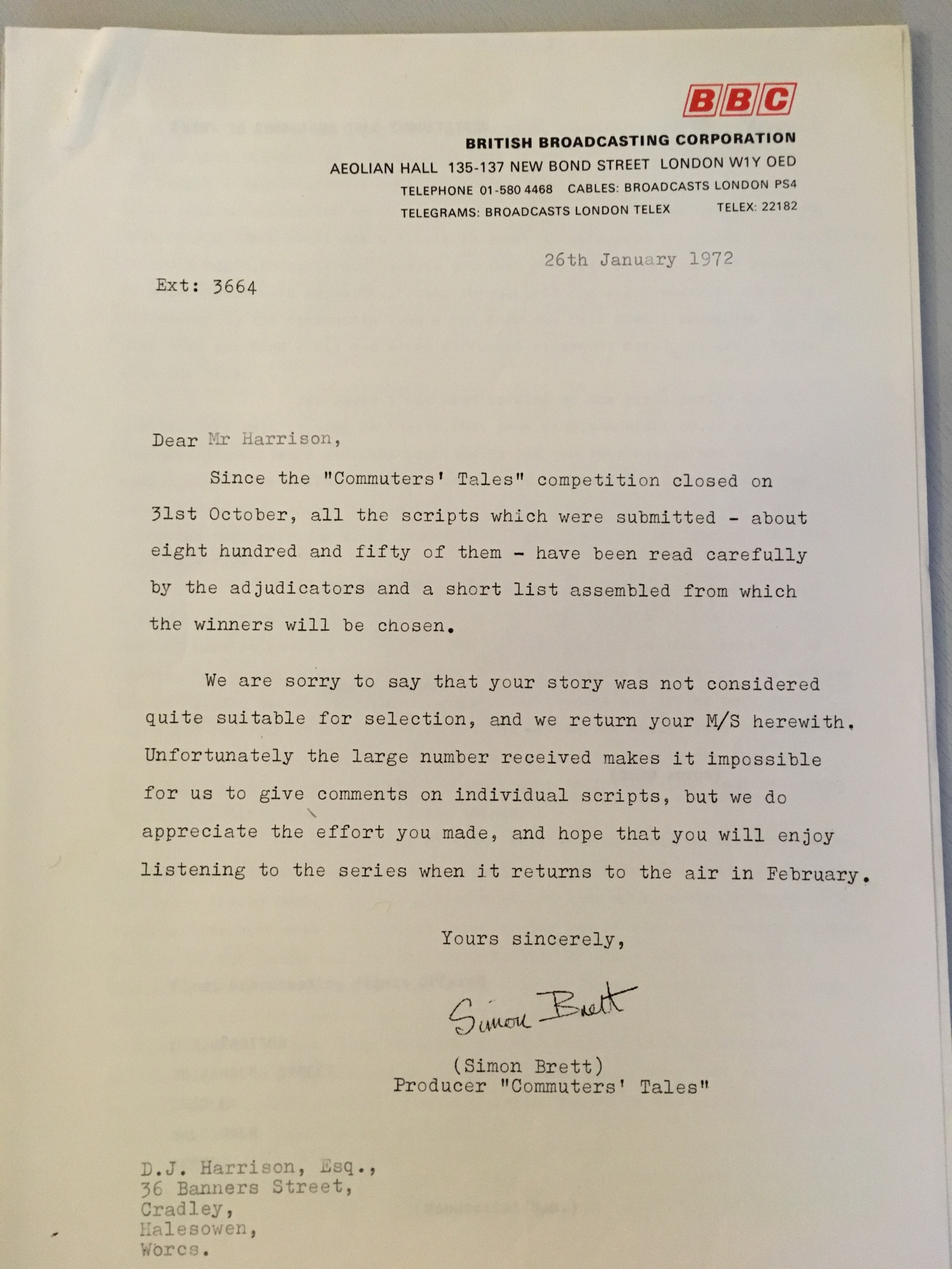
This is the result of the previous submission I made to the BBC. Note the date. January 1972. It's taken me this long to recover from the feeling of disappointment. OK, I suppose I'm not quite there yet.
In 1972, submitting a script was much more difficult than it is today. There were no computers, printers, photocopiers, email, internet or automatic spell checks. I had to type out my manuscript on a typewriter, a process akin to carving out letters on to tablets of stone. Mistakes were impossible to correct. They hadn't even invented Tippex in those days.
The kindest thing I can say about my 1972 submission was that it was typed reasonably neatly.
I'm now used to working with an editor, as you will have gathered from previous posts. I love the freedom this gives my novel writing. I am relieved from having to guess what works and what doesn't. An editor tells me in no uncertain terms. I'm more happy to accept criticism these days now that I recognise it as an essential part of my writing process. You note I use the term more happy and not just happy.
I've (bravely) put the BBC disappointment behind me and have sent them another script, 55 years on from the first (and only) one. This temerity has to be laid at the doorstep of that distinguished Irish writer and friend, Daragh O' Reilly. He's developed a bee in his bonnet about radio plays and, just so that I can spend some time with him, I joined him on a course about them. I've always been a big fan of Radio 4  and the prospect of getting something out on the airwaves is a delicious one however remote the possibility might be. Writing for radio is very different to writing a novel. My story arcs tend to be vast, requiring several hundred thousand words to complete. I write novels in batches of three or four. A 45 minute radio play needs only about 7,500 words. This is all a bit sudden for my liking so I've submitted the first episode of a six-part series.
I need to get back to the third Tyrant book now, but, before I do, I'll finish a new radio play that I've started . Then Daragh and I have a joint one to complete. Maybe I'm catching some of what he's got.

26 November 2016

Inspiration


As Stephen King will tell you, writers rarely ask each other where they get their inspiration from because we don't know. The more we think about it, the weirder it becomes, so we tend to take it for granted that the ideas will flow.
Some of us find inspiration comes more easily than others. There's this horrible thing called writers' block that gets in the way some times.
I'm very fortunate to have worked with the brilliant and insightful Barbara Turner-Vessalago for many years now. She has taught me the process that I use whenever I write. It doesn't matter what I'm writing, this really works for me.
Most of the time, I'm writing a novel. I used to think that a novel was an enormous almost never-ending task. I was often so daunted by the immensity of it I would feel like giving up. Then I learned that any piece of writing has to be written one word at a time. One word isn't so difficult to do. The next one comes even easier than the first and I'm away.
My starting point is almost always a place into which I parachute my characters and allow them to have a good look around. Then I see what happens and write it down.
Barbara's writing process is called Freefall and I heartily recommend it to you. I have found that most books on writing craft only become useful when I've more or less finished what I'm writing and am looking for technical assistance to make it work. Freefall is so wonderful because it gets me going. Starts me off. I lower my self into a time and place, sniff the air, listen to the rustling of the wind in the trees, narrow my eyes against the setting sun and...
I think you've got the picture.
Until recently, the only access to Barbara has been through her workshops in Canada, Australia and two per year in the UK. I'm lucky in that I've managed to attend at least one a year since 2007. Now, she has published two books on Freefall. Get them. You will find them useful and inspiring.

https://www.amazon.co.uk/Writing-Without-Parachute-Art-Freefall/dp/1908363045/

https://www.amazon.co.uk/Freefall-into-Fiction-Finding-Form/dp/178592172X/

At the moment, I have the fourth Jenny Parker novel away for copy edit. The two Tyrant fantasy novels are sitting in a proverbial drawer maturing and my SF novel, Voyager, has just reached the 30,000 word hump which means it's now got a life of its own and all I have to do is watch what happens and write it down. So I've taken a couple of weeks out to write a radio play. This is really good fun and a complete change to my usual form. As a prelude, I attended an inspirational one-day course presented by a radio producer called Polly Thomas. If I like what I produce, I'm going to actually submit the script to the BBC, who sent me the only rejection letter of my career in 1972.
Wish me luck.


photo credit: SFB579 Namaste Candle-Light via photopin (license)

9 November 2016

Nanowrimo


It's November and time for the horribly named Nanowrimo which provides encouragement for writers to get down and write like hell for a month. 50,000 words is the target and it takes daily dedication in order to achieve it.
I've often referred to the desirability of a daily writing habit and how writing just a little bit every day can accumulate into a major work like a novel. I write about an hour or so most days, sometimes much more but rarely much less. This gives me an output approaching Nanowrimo proportions most months of the year.
As you can see from the banner, I entered Nanowrimo in 2014. I did this specifically to write the fourth Jenny Parker thriller when I'd already committed myself to a fantasy trilogy and a SF novel. It wasn't going to get done otherwise.
The reason for telling you this is twofold. First, if you need an excuse to write every day, a word count objective can be helpful. Secondly, I want to describe what happened to my script after Nanowrimo.
The first draft of Exit Strategy, as it has become titled, was actually 90,000 words and was written during October, November and December 2014. I then put it in a virtual drawer and carried on with my fantasy novels. In the middle of 2015, I went back to it and tidied it up so that I could send it to my editor. She did her work and issued me with her usual very detailed and perceptive structural edit. This provided the basis of a rewrite, which I completed in May 2016 and called the second draft. This went back to my editor and she provided another detailed report which was used to create a third draft which I sent her in September 2016. This third draft, notably, included a new beginning, a new ending and several injections of pace into the middle. It also changed much of the plot. In other words, draft three was a very different novel to draft one. A much better one in fact.
Draft three was submitted to my editor and she marked up all the areas that needed attention in order to maintain consistency. Draft four was produced a couple of days ago and has now gone back to my editor for a line edit. Up to now, all the editing has concentrated on plot and structure. Now I've established what I'm writing about, we can start working on how it's been written. The line edit will smooth over the words so that my readers can enjoy the story without being constantly dragged out of it by clunky expressions.
I expect the line edit to be done by the end of this year. Then I'll have to go through it and make the changes necessary before the final process, proofreading, is done. Proofreading clears up glitches, typos, formatting inconsistencies and that kind of thing. Once that's done, Exit Strategy can be published.
In summary, I finished 'writing' Exit Strategy at the end of 2014 and expect it to be published in early 2017.
Many people do Nanowrimo and self publish immediately. If I had done that, you'd be getting something quite awful, virtually unreadable and certainly not worth your time.
After two more years of work, Exit Strategy will be the best it can be. And I can be proud of that.

4 March 2016

Plodding along


Sometimes its all you can do, plod along. Rapid progress is always nice but rarely achievable. Doing big things in one fell swoop is generally impossible and is very daunting. Like writing a story. Whether its a novel or a short story there's little prospect of doing everything required at one sitting.
So, best not to try.
Many times I've heard the refrain 'I'll write my book when I'm [insert here a set of conditions that might never happen].' Nobody has the time to write. There's always something that needs doing. That's why a writing habit is so important. Writing every day, even if it's only a few words, is the best gift you can give yourself.
The arithmetic involved is compelling. I can write about a thousand words in an hour. So, if I wrote for twenty minutes a day I would have 121,000 words a year. A fat fantasy novel or two skinny crime thrillers! Twenty minutes a day!
I'm sorry to bang on about this but if you can't grant yourself twenty minutes to do what makes you feel good then you're not having a good day.
So I'm telling you to write every day.
I'm also suggesting that if you don't manage to write then don't feel bad about it. Be kind to yourself. But remember that writing is actually being kinder to yourself than forgiving yourself for not writing.
Then there's another thing. Write for yourself. Don't worry about readers in general or a reader in particular. In my experience, if you don't have fun writing it then nobody is ever going to have fun reading it. Equally, if your guts aren't churning with emotion as you put down the words chances are that it will leave most readers cold.
The publishing bit has been dealt with in numerous previous posts (as has this advice). Don't worry about markets or genres or what you think might grab the eye of a literary agent. By the time you've competed your story, the market will have changed anyway.
Do seek help in improving your writing. Join a writers group, find someone to mentor you, don't take any notice of the effusive praise lavished on your work by your friends and family.
Plod.
That's my heartfelt advice.
It works for me.


Image courtesy of Freeimages.co.uk

19 October 2015

Literary Agent


Who needs a literary agent in the modern era of book publishing?

Well, I do for a start and I'll tell you my reasons.

I have a limited amount of energy. You might also describe it as time but I prefer the use of the word energy because energy determines what I can do with my time. As you may be aware, I'm a partner in a publishing business as well as being an author. My crime thrillers have sold well, particularly as ebooks, and I've picked up the skills and experience that a publisher needs. So I know how to get cover designs, format manuscripts, employ editors and produce good quality books that people are happy with. I also know the best ways to get our books noticed, including Facebook and Twitter, and who can help me grow our market.

I would, however, rather be writing. That's what makes me happy. I do get some fun and satisfaction from all the peripheral tasks involved in producing a book but once the novelty wears off it does seem a bit too much like work.

My ambition was always to write a full length novel. I've now finished nine of them since 2007 and three have been published. That was my second ambition, to be published. Then I wished that people would buy my books and they did. I really wanted some indication that they had read and enjoyed them and lo and behold they wrote very positive reviews. Whew! My wish list appears to have been fulfilled.

But not quite, we humans are beggars when it comes to wanting even more. Now I feel that I want to expand my readership, especially now that I'm writing fantasy as well as crime thrillers. In order to do that I need an agent. Someone who will champion my work. Someone who has the boundless energy and know-how required to deal with mainstream publishers. Someone who has a vested interested in my success because they are investing their time in the project. Agents are purely commission based, they have to back the right horses and then ride them to the finishing line before they get paid. That's the energy I need. Yes they take a proportion of my earnings but they're welcome to it, they'll have earned it.

I'm convinced I've found the right one but there's every chance that she won't have me. All I can do is ask her nicely, which I've done.

Wish me luck.


photo credit: Ann Arbor Cook Book, 1899 -- frontispiece advertisements. via photopin (license)

5 October 2015

Jeremy Corbyn


The election of Jeremy Corbyn as the Labour leader has been a disaster for me. Where do I start in order to explain?

Ah, yes. Movember 2015. The month I decided to grow a moustache for charity, an act that proved strangely prophetic but more of that another time. Once Movember was past I decided to retain my facial hair on the grounds that my primary relationship had improved because my wife dissolved into laughter every time she looked at me.

Movember turned into Decembeard. I went the whole hog and stopped shaving altogether. My face became spiky and uncomfortable to the extent that my new grandson would squeal if I held him close. Still I persevered as it was for a cause that turned out not to be as good as I had imagined, but that will need a whole blog to explain so we'll not go there right now.

In January, I watched a film called Finding Forrester. I recommend this if you've not seen it. You can get it free if you've a Netflix subscription. Sean Connery played a distinguished writer in the film. Part of his being distinguished was the beard he wore. I modelled mine on his and every time I looked in the mirror I murmured James Bond quotes in a peculiar accent that I fondly imagined might belong to Connery. My wellbeing and self-esteem were greatly improved at a time when I needed a boost. Walking around looking like Sean Connery's portrayal of an author felt pretty good. It ticked plenty of the boxes that I might have been inclined to tick had I been in the habit of filling in surveys. I never do surveys, even the ones that offer fabulous prizes just for spending ten minutes of my time. The nearest thing I do to surveys is occasionally respond to consultations which are relevant to my work. These are Government exercises and don't even have the merit of offering a free iPad if you're drawn out of the hat. It's important to respond to these because it's good practice in being ignored. By the time a consultation has been sent out, someone has already decided what the change in legislation is going to be, regardless what response they get. I once asked a Treasury official why they decided to change when ninety percent of the consultation responses urged them to leave things as they were. 'We obviously consulted the wrong people,' was the reply.

Where was I? Oh yes, Jeremy Corbyn.

I'd never heard of Jeremy Corbyn before the Labour Party leadership election. More importantly, neither had I seen a picture of him. Now it's too late, he's been elected and disaster is staring at me from every mirror. He's got my beard. Or, worse, I seem to have a beard exactly like his. People at work have started to call it a 'Corbyn,' I know they never called my beard a 'Connery' but silence is indeed golden when it comes to facial hair.

Jeremy is here to stay. Even if he resigns on principle tomorrow, the damage has been done and can't be undone. None of us can unlook at something so that it's erased from our memory. Pity. If Men in Black hadn't got there first that might have been the basis for a good story.


photo credit: Jeremy Corbyn spoke out against TTIP via photopin (license)

18 September 2015

Violence


There are many violent things happening in the world. The murderous actions of extremists are on the front pages of our newspapers on a regular basis. In reaction, governments pledge to drop more bombs in the places that the terrorists might be. The term is fighting fire with fire. In the real world, it's what the general public seem to require of our politicians.

In the fictional world of Jenny Parker, violence isn't an option for her. Even if it were available to her, which mostly it's not, she realises that the kind of people she has to deal with actually thrive on violence. It's something they understand. Jenny has to find other means of saving herself knowing that threats of retaliation in kind aren't going to change her antagonists' mindset.

If someone's trying to kill you shouldn't you just kill them first? Isn't that the only way?

I don't believe it's that simple. I find plots that rely on a hero being able to out-fight, out-shoot or out-muscle the villain somewhat unsatisfying. There is, of course, a degree of might-is-right inherent in the way we humans conduct ourselves and it's a horrible fact to contemplate. But that doesn't mean violence has to be the only way out of a difficult situation.

One of the reasons I write the Jenny Parker series is to get away from the convention that a hero has to be able to beat up the bad guys. My old karate teacher, Billy Higgins, used to say that a good big 'un will always beat a good little 'un. He also taught me that, regardless of how proficient I might be, someone bigger and stronger would most likely kick my ass. The point of the training was to be able to defend myself long enough to be able to run away. Sprinting is a noble form of defence, in my opinion. Mind you, I only progressed to the level of yellow belt which some might find highly appropriate.

Jenny Parker doesn't have super powers, nor does she wield a samurai sword to deadly effect. She has to think on her feet and talk her way out of danger. It doesn't always work, mind you.

In the world of thrillers as in the real world, I firmly believe that violence will never bring a satisfactory resolution to a conflict. There are more subtle and effective means. And these are much more interesting to me and, I hope, to my readers.


photo credit: Explosion (Verleitung, Ablenkung beim SEK-Einsatz) via photopin (license)

27 June 2015

Amazon Royalty System


By the time you read this, Limited Liability may have been voted Book of the Year. Thanks to everyone who voted for it.
This whole book promotion and awards thing got me thinking. What am I really trying to achieve with my writing?

Then the news came from Amazon that they were changing the way they pay authors on Kindle Unlimited and Kindle Owners Lending Library. It used to be that if someone borrowed one of my books I got an equal share of the fund with everyone else whose book had been borrowed. Now I get a share which is calculated from the number of pages read. I don't know about you but that seems perfectly fair to me. It means that a writer is rewarded for writing well and that authors whose readers can't get beyond the first awful page get nothing.

Brilliant.

The KU/KOLL thing only applies to books which are exclusive to Amazon so almost all of them are unreadable self-published crap anyway. The new arrangement will be interesting.

Which brings me back to my original question which I'll pose in a more specific way. If a hundred thousand people bought my book but none of them read it, would I be happy? I doubt it, even if I did have all those royalties in my bank account. What if they all read it but none of them liked it? Again, I'd be rich but unhappy.

Which leads me to the conclusion that I'm writing in the hope that my books will be read and that my readers will enjoy them. So why not give away my work for free? Two reasons. First I need to at least pay my editor, proof reader and cover designer. Secondly, it would brand my work as worthless. There are so many free books out there that most people are no longer interested in them.

I've been very fortunate that my books have been promoted by best selling author Stephen Leather without whose help I wouldn't even be published. Because I've had this help, the Jenny Parker series has done well in terms of sales. The question I ask is have the people who bought my books actually read and enjoyed them?

I just realised that I can answer that question. I have sold several thousand copies of the second Jenny Parker novel, Proceeds of Crime. Those readers will almost certainly have read the first, Due Diligence, and liked it enough to buy the second.

So there you are, I can be officially happy according to my own terms of reference. I can also stop agonising over book sales and Amazon reviews.

I've just finished a fantasy novel involving a character called Tyrant. I enjoyed writing this more than anything I've ever written. It will be out in September and I hope you enjoy it as much as I did.


Pageviews