Showing posts with label Limited Liability. Show all posts

29 October 2020

Reviews Part Two


For years, my first Jenny Parker novel struggled to get reviews. There were a fair number of sales, but reviews were hard to come by. Then I wrote the blog previous to this one.

Unbeknown to me, my publishers had created a big promotion for the Jenny Parker series around the same time.

Normally, my sales are communicated to me with my royalty statement on a six monthly basis. A very good half-year might involve a thousand sales. I'd not had a good one for quite a long time. We're talking a few dozen sales.

I went to an old friend's farm to give him my rescue chickens. This isn't a digression, though it might sound like me going off at a tangent, because his partner and her friend have been keen readers of my books for years. A socially distanced chat revealed that she hadn't read the latest Jenny Parker book and she rang her friend to tell her there was another treat coming her way. I offered to send her a copy but she said she was happy to buy one.

OK, I'm getting to the point. Be patient.

If I want to see how my books are doing, I go to my Amazon author's page and look at the charts. One sale makes a big difference when you're selling very few books. You can soar from number 1,000,000 to number 50,000 in an instant before gradually decaying back down to earth.

On a promise of a sale, I checked my Amazon page. All my books were doing ridiculously well. Due Diligence was second overall in the UK and 3rd overall in the US. Obviously there was a glitch with the figures so I checked with my publishers. No glitch, more than 30,000 downloads, they said.

I was gobsmacked and happy. Then the sales persisted. Then the reviews and ratings began to accumulate. DD has well over a hundred positive reviews now.

So, I'm telling you that writers should never give up. Success can come at any time. And when it does, I have to remind myself to taste the sweetness instead of wishing for even more.

One sale is enough to make me happy. One positive review increases that happiness tenfold.

Despite the pandemic, there's a big smile on my face most of the time now.


21 July 2019

First Principles


We all know about Climate Change. Believing it is one thing, doing something about it is another. Then there are prominent related issues like Biodiversity and Plastics in the Oceans. The situation is pretty much overwhelming. It's hard to believe that any individual can make a difference.

We're constantly being fed conflicting information. This is designed to confuse and frustrate our good intentions. If there's a report on how a plant-based diet is not only good for our health but of enormous benefit to the planet, the media will respond with 'research' based evidence that meat is good for us and that vegan families are risking the health of their children by such faddism.

Let me try to help by explaining my approach. When I was studying Chemistry I found that provided I understood the first principles I could avoid having to remember huge amounts of information. So it is with the environment. None of us can know and understand every consequence of every action. Life and our relationship with the planet is much too complex for that.

I'll give you an example to begin with.

Fracking. Why do we oppose fracking?

Proponents of fracking will argue that we need gas, that there is no risk, that the earthquakes are small and that opponents should back off.

The anti-fracking brigade cite horror stories about contaminated water supplies, the loss of value of homes adjacent to fracking sites, flammable gases coming through domestic water taps and lots more.

My advice is to forget all that. Risk assessment is subjective. Go back to first principles which is that fossil fuels have to be left in the ground if we are to mitigate climate change and avoid extinction. Extracting gas puts the carbon it contains into the atmosphere. Simply put, fracking will make climate change worse. That's enough for me.

The country, and some councils, have declared a climate emergency without doing anything except shout about it. We need to dramatically reduce our use of gas. There will be no market for fracked gas if we do that and the frackers will give up because they're only in it for the money.

The Committee on Climate Change has advised Government that 800,000 households a year need to be converted to sustainable fuel from here on in if we are to reach our carbon reduction targets. Yet almost all new houses are being fitted with gas boilers. This is wrong. Councils can and must stop this. There are alternatives and these are much cheaper if installed at the building stage rather than having to retrofit.

So that's the first principle:
Anything that will make Climate Change worse has to be avoided.


30 December 2018

New Year


Happy New Year!

Here are a few tips that might help make 2019 a good writing year.

1. Write

Seems obvious, doesn't it? However, by waiting for the right time and perfect conditions I wasted many years of opportunity. Write a little bit every day. This is hard, I know, but it can be done.

2. Don't Edit

Write the piece in its entirety without going back over it and making changes. Finish it. This is even harder than number 1.

3. Write something else

This is the advice I give to anyone who sends me their work. A finished piece is best put away for a while before trying to assess it.

4. Don't Self-Publish the first thing you write

I know that intense feeling of temptation to upload my novel as soon as I've finished it. After all, if people can't buy it how do I become the next J K Rowling?
I was fortunate to avoid this catastrophic error and my writing career was saved. Anyone trying to read the first novels I wrote would have avoided me like the plague for the rest of time. And been quite right in doing so.

5. Just because it's been written doesn't mean anyone should read it

Believe it or not, this is a liberating thing. I avoid 'writing for publication' and write for myself. Always. Or at least I try not to second guess what the public might like because I have absolutely no idea. I do, however, know what I like. Write the book you want to read.

6. If you do publish, do it properly

There will come a time, I hope, when you've produced something you think might be of interest to a wider public. When that time comes, it is important to present it in readable form. In other words, it will need a professional edit. This will cost money. A lot of money in writing terms. Almost certainly more money than you will ever recoup in sales.

7. Writing is not a competitive sport

Any success I've had has been dependant on help from other writers. The writing community is a wonderful resource. Join it in whichever guise suits you. Your local writers' group is a wonderful place to begin.


photo credit: Sworldguy Fireworks Explosion via photopin (license)

21 October 2018

Unruly Chracters


As you might already be aware, I try to write a bit every day. I wake up in the morning and find myself enveloped in the story. I look around and see the characters who then begin to do things. Sometimes unexpected things. Unintentioned things. Exciting things. That's what makes writing so interesting for me. It's the not knowing.

When I get almost to the end of a story and realise what's going to happen, it becomes more of a struggle to write. It's as if my mind has finished with the project and is no longer interested.

I have been a little bit poorly of late and unable to write. Now I'm recovered and back at it, I find that my characters haven't had the patience and good grace to hang around and wait for me. Instead, they seem to have carried on regardless and what was a nice linear plot line involving four of them in a voyage of discovery has fallen to bits. I left them all on a perfectly good ship complete with crew, provisions and a clear plan. On my return, I find the ship is gone. I have no idea where it is. One of my characters is sitting on the shore feeling sorry for himself. Two more are wandering around in a jungle when they should be on the ship. These are the least of my problems. My fourth character has disappeared completely.

You might think it would be easy to find her. I'm the writer, after all. The fantasy world I've created is a bit short of detail, though. I only know about the places my characters have actually been. She may have gone somewhere new. Or even hopped out of this particular version of reality into a completely different one. She can do things like that. She's a witch.

OK, I'm currently writing fantasy but my process is the same for my crime thrillers. I'm with the reader all the way. I know what they know. I can speculate, just as they can, and I do this in the same way whether I'm writing or reading someone else's story.

Another thing I should mention is that my characters appear fully formed. What I mean is they have lived their lives outside the confines of my story and their motivation derives from experiences I have no knowledge of. Usually, I get to understand them better as the story unfolds. That's what makes them interesting.

Like my witch. After 250,000 words of the story, I'm at last beginning to understand the reasons behind her behaviour right at the beginning. What she did then is only now beginning to make sense.

Are writers supposed to carefully design characters down the the colour of their eyes and the toys they received for their first Christmas? Should they always know what's going to happen at the end of their story? 

Am I the only one who writes without knowing anything?


photo credit: Jrwn Photography Natcha via photopin (license)

22 September 2018

Science Fiction


Science Fiction is my favourite genre. I'd love to write a really good SF novel. Better still, I am going to write a brilliant SF novel, you just wait and see.

As a child, I would be taken to Tyldesley library every Saturday morning where I would gather my stock of books to last me a whole week. I can't remember how many I was allowed to borrow at a time but however many it was, it was never enough. Which meant that I had to read everything I borrowed. This was a very good discipline because it prevented me from falling into the habit of abandoning books without giving them a chance. Just like my Friday evening visits to the cinema, I made the best of what was on offer.

My go to books were the bright yellow sleeved Gollancz ones. I worked my way through them from Aldiss to Zelazny. Two particular favourites that I remember were Samuel R Delany and Theodore Sturgeon. Happy days.

I also like Fantasy. Traditionally, Fantasy involves swords, elves, dragons and similar things whereas SF has spaceships, robots and technology. Many of these are interchangeable but the defining element is often said to be magic.

The problem with magic is that it has to be carefully defined for it to be a useful plot element. It's too tempting for a writer to suddenly conjure up a new piece of magic to help his protagonist out of a tight spot. That kind of behaviour plays havoc with dramatic tension and has the reader relaxed and waiting for a new miracle at every crisis point.

The SF equivalent is, of course, technology. Star Trek provides plenty of wonderful example of how not to use technology in a story. Suddenly deciding that reversing the dilithium crystal polarity to  save the Enterprise from doom can be a bit weak unless you've tried it at least once before and shown the reader or viewer some potential negative consequences.

It's easy to be lazy when you're inventing your own technology or dreaming up magic spells. That's why I think that the very best of both genres ranks with the very best writing ever. I also recognise that the opposite is undoubtedly true.

The most recent SF book I read was Dogs of War by Adrian Tchaikovsky. It's superb. Highly recommended, as is his Nebula Award winning Children of Time. One of my all time favourite SF reads is the Algebraist by Iain M Banks, though every book he wrote contains much to savour.

As for Fantasy, it's hard to look beyond the Hobbit. Some might say this is the book that shaped the genre for all time. However, I can't not mention Joe Abercrombie and the First Law series. Joe is in a different class entirely to every other Fantasy author.

So, one day I'll have my own masterpiece to add to the pantheon of SF. All I have to do now is to write it and convince Gollancz to publish it.

Watch this space.


photo credit: jaci XIII New family via photopin (license)

15 September 2018

Taking Stock


On the day that my second Jenny Parker crime thriller is published by Endeavour Media, I am taking stock of where my writing is up to.

The third Jenny Parker, Limited Liability, is scheduled for publication in October. The fourth, Exit Strategy, is done and dusted. Written, revised (many times), edited, rewritten, edited, finalised and copy-edited. Polished to a burnished hue. Ready to go.

I'm currently writing a fantasy series. Three books. The first two are drafted. I've already completely re-written the first after feedback from an agent and it's much better. The third Tyrant book is well under way.

The rest of my recent output is looking for an agent that can get the best out of it.

A stand alone novel about a father-daughter dysfunctional relationship.

A novel based on the early years of my waste management consultancy.

Two Palmer and Jones books (humorous crime novels).

A childrens book, Unipig.

A toddlers book (Not for Bedtime).

A book about the ancients gods of Sumeria (in process).

Then there's my SF trilogy, Technical Difficulties. I wrote these around ten years ago. All I can say about them is that they were good practice for the discipline of writing. They will never see the light of day. At least not in their present form. I've started a rewrite, of course I have, but it's got bogged down in 1977 Las Vegas. Not the best place to leave your characters.

Now I need someone to look at all this stuff and help me decide where to concentrate my efforts. Meanwhile, I write what comes up and there's plenty that is.

5 August 2018

The Ten Minute Rule


Give it ten minutes.

It's a symptom of the modern age that we have less and less attention span. The situation hasn't been helped by the advent of streaming. We can get movies and books instantly. If we don't like the one we're watching or reading, we can change at the prod of a finger.

Once upon a time, I used to have to go down to the local Blockbuster video store and physically borrow a copy of a film. An even longer time ago, I would go to the library every Saturday morning for my weekly ration of reading matter.

Either way, movies or books, I was stuck with the selection I'd made. If the film was rubbish, I'd watch it anyway because I'd taken ages to choose it, queued up to rent it, paid for it and driven there and back. And there wasn't anything else for us to watch. If the book I'd borrowed was a bit dry, I'd read it anyway.

Now I have Netflix and Amazon and iPlayer and Kindle and iBooks. If what I'm reading or watching isn't doing it for me, it's liable to get replaced by something else. Instantly.

That's what I call the ten minute rule. Sometimes ten minutes is being over-generous with my time. A good film has me forgetting that I'd decided to give it ten minutes because I get absorbed.

As a writer, I feel compelled to give books a bit more room to impress me. A slow start doesn't necessarily mean a bad book. However, I'm conscious that many readers these days aren't so patient. Books are chosen on the basis of the cover and then the first few sentences. Quite honestly, I'd be happy if readers would give my books a whole ten minutes.

Which makes it incredibly satisfying when people do read my books from cover to cover. My publishers recently promoted my first Jenny Parker thriller in Australia and we sold lots of copies. What was most exciting, though, was the number of people that bought and read the other two in the series. Unless I'm deluding myself, these wonderfully astute readers must have enjoyed their first taste of Jenny Parker to be willing to pay for more. Nothing could be more satisfying for an author like me.

Having said that, I'm constantly aware of the need to make my books as instantly compelling as possible. There's no room for shilly-shallying about in the modern novel.

The ten minute rule sees to that.


photo credit: marcoverch In letzter Minute via photopin (license)

26 March 2018

Nowt on Telly


If you're like me, you've spent a fair amount of time watching things on TV that, in hindsight, seem a complete waste of time. Then you watch the next instalment if only to see if this one's any better than the last. Perhaps, as I have, you've become inexplicably hooked by a couple with more money than sense being filmed looking for a property in the country.
If I see one more undercooked rack of lamb on Masterchef I may throw up.
There's an antidote to the hollow feeling that comes from wasting an evening in front of the box. It might be hard to swallow for the first few attempts but it's well worth persevering. If you do, a whole new richness will enter your life. Every day will hold the promise of discovery and excitement. Life will feel that much more worthwhile.
There's a magical effect produced when a TV is switched off. Your attention becomes your property again. You can do with it whatever you wish without it being constantly dragged to the screen.
Then there's the silence. Opportunity for stillness. Your mind relaxes, free from a constant bombardment of images and sounds.
So what do you do instead? What's this magical alternative to relaxing in front of the telly?
Read a book.
It's the best antidote to boredom and that empty feeling of having wasted time.
Ok, I'm an author so I would say that, you might think. There he goes, trying to peddle his books, you might say.
In response, I admit that I'm as affected by TV in all its forms as anyone. I waste vast amounts of precious time slumped on a sofa in a semi-comatose state.
As soon as I pick up a book and start reading, I feel so much better. Reading is a much richer experience than TV can ever be.
I'll prove it to you, if you have any doubts. Read any book that has been adapted for TV, then watch the program or film. It's become a cliche that the book is always better than the film but this just isn't fair. A book is a book and a film is a film. They're different media. You can do things in books that films, even using the most sophisticated computer generated imagery, can't possibly display. The greatest actor on the planet can't hope to communicate feelings with the same intensity that living inside the character's head can.
Try Lord of the Rings, even if you've seen all the films.
Read The Handmaid's Tale, even if you saw the TV programme.
Read The Shining, then watch the film.
Read anything by Iain Banks, David Mitchell, Haruki Murakami, Neal Stephenson.
Why not try the greatest crime writer in the history of the world, Raymond Chandler? His books have been made into films again and again. The Big Sleep is a particular favourite of mine.
You don't even have to buy a book. We have a brilliant library service in Lancashire.
If you do want to make a purchase, support an independent book shop.
By the way, there's a TV adaptation of China Mieville's The City and the City coming on the BBC. Get the book. Immerse yourself. Then enjoy the program in a very different way.

11 January 2018

Stranger then Fiction


Truth is stranger than fiction. This familiar saying is a quote from that master storyteller, Mark Twain. Any writer of fiction, like myself, has to bear this in mind.
Why?
Well, I suppose it's because too much realism can be difficult for a reader to swallow. Real life tends to be fragmented, things happen that are often completely unrelated. The relative importance of events can be very hard to judge and often remain opaque. Things come and go. Things that seemed to matter one moment fade into complete insignificance.
None of these aspects of reality are conducive to telling a good story. In fiction, it's essential to have a structure. A beginning, middle and end. There has to be a satisfactory outcome for the reader, something that can't be guaranteed by a factual account.
You might have observed that books, films and TV programmes based on true events are always heavily dramatised. The complexity of the real has to be simplified and carefully presented in order to tell a story in a way that will hold an audience. Outcomes, especially, are manipulated in order to deliver that essential happy ending.
Here's an example of what I'm trying to say. Consider this as the plot for a thriller.

The Russians invade Ukraine on a pretext. They arm the local thugs and support them with Russian soldiers who are 'on holiday' there. A Russian-supplied ground to air missile system is deployed to shoot down a civilian airliner and kill hundreds of innocent men, women and children. The AA battery is quickly spirited away back to Russia and vigorous denials are issued.

The CIA find satellite evidence of Russian involvement in the atrocity. Secret agents in Russia collect damning information about the incident and also uncover links between the Russian leader and organised crime. More diligent investigative work discovers billions of dollars of offshore funds linked directly to Putin.

OK, so far so good. Let's put an ending to it:

In a race against time, a plucky CIA agent puts all the information together and then manages to dash to the UN building, through a hail of FSB bullets, and give it to the US Ambassador. A Security Council resolution proposed by Russia is blocked when the revelations are made. Russian allies voice their disapproval and withdraw support. Hundreds of thousands of lives are saved in Syria as the disgraced Russian regime is prevented from continuing to support the vicious Assad regime. A popular uprising in Russia ousts the president and the world becomes a better and more peaceful place.

This is the kind of thing required to make a good story. Of course, it's fictional. The true outcome is as follows:

FIFA decide to hold the World Cup in Russia.

See what I mean?


photo credit: Delta_33 Malaysia Airlines 9M-MTC Airbus A330 via photopin (license)

24 November 2017

Growth


Stephen King considers The Shining to be his breakthrough novel. Instead of doing more of the same that had earned him fame and fortune, he consciously decided to make the Shining something more. The way he did it was to concentrate on the character of the father and his upbringing so that the demons that afflicted him later on in the book are as much internal ones as the result of supernatural forces. According to King, being propelled by some external irresistible force provides too much of a comfortable excuse and dilutes the power of the narrative.

I found this insight extremely valuable and it has changed the way in which I view my own writing. My crime fiction books are primarily plot driven. Fast paced, breathless even. I try to pack as much story into each paragraph as I can. There's nothing wrong with that. As Vonnegut advised, I try to spend  my reader's time as wisely as possible.

Lately, though, I've been working with my writing mentor on a project which is more an examination of character and relationships than whirlwind narrative. For me, it has been a completely new way of doing things. I'm a great proponent of the write the whole thing and don't look back until you've finished method. It has served me very well in the past and has the great merit of not having to make any judgements as I go along.

For this novel, and it's grown to novel proportions already, I'm constantly trying things out because I have the great benefit of someone I trust who can give me an opinion. There's been a lot of stuff that I've submitted which hasn't gone down at all well. Fortunately, I've sufficiently matured as a writer to view negative comments as even more valuable than positive ones. Sometimes I find it hard to agree with them but most of the time I'm able to reflect on the truth behind them and take them on board.

This has resulted in lots of rewrites, many versions of the same scene, drastic plot revisions galore. For example, an early version had the protagonist in a hospital bed paralysed apart from a couple of fingers on one hand which he used to type long accounts of early childhood. This might immediately seem cumbersome and overly melodramatic to you but it took me a while to get that myself.

I don't know if this will be my breakthrough novel and, quite honestly, it might not even see the light of publication. What matters is that I feel that I'm growing as a writer all the time and that's important.


photo credit: JoeInSouthernCA Vintage Movie Poster: "The Shining" via photopin (license)

11 August 2017

Washy-Wishy?


I saw this thing on the BBC website and loved it enough to want to tell you about it. As a writer, I love words and what they can do. I also recognise that years of practice have instilled in me some basic rules that serve me well. A writer's job is to tell a story and not to advertise the way in which the story's being told.
If I write a clumsy sentence, or even a single inappropriate word, the reader is immediately pulled out of the situation my protagonist is faced with and back to reality. Do that often and any reader will put down my book in disgust and give up. Having a compelling plot and interesting characters isn't enough. The story needs to flow in a way that a reader will find comfortable and satisfying.
There are many craft books out there that help a writer to understand what works and what doesn't. However, there are some extremely powerful rules that are instinctive and rarely expressed.
Take this, for instance:

Adjectives in English absolutely have to be in this order: opinion-size-age-shape-colour-origin-material-purpose Noun. So you can have a lovely little old rectangular green French silver whittling knife. But if you mess with that word order in the slightest you’ll sound like a maniac. It’s an odd thing that every English speaker uses that list, but almost none of us could write it out.
The Elements of Eloquence by Mark Forsyth

Break this rule and, as the man says, you'll sound like a maniac. Which will be off-putting to your English wonderful readership. ARRGH! See what he means?

Of course there's more too it, there always is. I can almost hear the cries of Big Bad Wolf. What about that then? Shouldn't it be Bad Big Wolf according to the rule, even though that would sound pretty awful?

The brilliant Mr Forsyth explains:

Reduplication in linguistics is when you repeat a word, sometimes with an altered consonant (lovey-dovey, fuddy-duddy, nitty-gritty), and sometimes with an altered vowel: bish-bash-bosh, ding-dang-dong. If there are three words then the order has to go I, A, O. If there are two words then the first is I and the second is either A or O. Mish-mash, chit-chat, dilly-dally, shilly-shally, tip top, hip-hop, flip-flop, tic tac, sing song, ding dong, King Kong, ping pong.

So linguistic reduplication is so important that it outranks the adjective sequence.

We don't have to learn any of this, it's all natural. Which makes it so powerful because my readers don't spot that I'm breaking any rules, they only know that it sounds wrong and they don't like it. So they stop reading. And I don't want that.

No more washy-wishy prose for me, I'm getting Mr Forsyth's book. 

https://www.amazon.co.uk/Elements-Eloquence-Perfect-English-Phrase/dp/1785781723/


17 July 2017

Is Kindle broken?


Amazon KDP has been good to me. Way back in 2013, Due Diligence made it into the top twenty crime thrillers and the overall top one hundred kindle charts. You can imagine how chuffed I was. I sold several thousand books in a very short time and all because Stephen Leather invited his readership to try it.

A few years down the line, services like BooksgoSocial and Bookbub will promote your book for a modest fee. They can be picky, though, as they depend on keeping faith with their readers and not fobbing off some rubbish on them. A lot like Stephen, who took the trouble to read the copy I sent him. Not like Stephen because he helped me for free, as he's helped lots of other writers.

Amazon, in order to promote their Prime membership, decided to offer free loans of books that were enrolled in KDP Select. At first they paid authors on the basis of downloads. Then they decided that this wasn't fair. Short books received the same payment as longer ones. It didn't matter if the books were read or not the author got paid regardless. Then Amazon decided to change the basis of payment. Every page read was recorded and totted up and the fund distributed accordingly. Seemed fair to most people at the time.

I quite liked it at first, I had a 'pages read' graph to go with my copies sold one. Some days, I'd pretend the pages read were the copies sold just to make me feel especially good. Then bad things started to happen. I got wind of authors' amazon accounts being removed because of anomalies in their page counts. One of my books took a leap skywards for no reason, thousands of page reads where there had been a steady few hundred before. I got cold feet and took all my books off Select. Losing your Amazon account is fatal for an author in these digital times and I realised that abuse of the new Amazon payment system was likely to become worse. I was right.

Recently, really awful books by unknown authors have been hitting the top of the Kindle charts. Books with very few and very bad reviews. They got their exposure and thousands of sales by what's known as clickfarming.

Clickfarming involves downloading the book hundreds of times and then employing someone to flick through each copy. Let's say a book is 200 pages. After each 200 page views are recorded, Amazon count it as a sale. Then the book is catapulted up the charts, people see it and they buy it.

Not only that, but the author is paid a share of the KU pot on the basis of every page read.

Some organisations offer this service to authors for a fee. Others take all the money themselves by uploading their own books, often computer generated or pirated.

In order to make it more difficult for Amazon to detect them, some clickfarms add some 'innocent' books to the ones they are pushing.

Amazon delete the accounts of anyone they suspect of clickfarming and this seems to have included authors who were completely unaware of what was going on. I've not heard of any successful appeals.

So, keep your eyes peeled, stay sharp and safeguard your precious account. If you're new to Kindle, think twice before enrolling in Select.


photo credit: ToGa Wanderings Free Internet via photopin (license)

4 July 2017

Publishing, self or otherwise

Writing


I was looking for an image that best represented much of my writing. This is stuff I had to write, stuff I enjoyed writing and stuff that helped me to get a better handle on the process of writing. All good stuff, as far as I'm concerned. Do people lie awake at nights longing to read this stuff?
No.
Neither would they thank me for offering it to them. In the unlikely event that they did read it, they would be mightily irritated. To the extent that they'd shun anything and everything I might show them in the future.
And I don't blame them. It's what I do.

Self-published books

This is an image representing self-published writing. The notice on the bin bag hasn't been edited or proof read, something that 99% of self-published writing has in common. Anyone that reads the label can see that what's inside is rubbish.

Write, by all means. Write as often and as long as you can. Write everything that comes into your head. But try to resist the impulse to publish it until you're absolutely sure it's the best thing to do.

Otherwise, when you do come up with something worth reading, any readership you might hope to attract has long ago written your name on their reading list and crossed it off with an indelible marker.

I was very fortunate. I wrote what I considered to be a cracking SF trilogy. Everyone who read it said it was awesome and brilliant. The problem was that my friends and family weren't professional writers and, worse still, are usually inclined to be kind to me. Neither of these factors was helpful in determining the merits of my novels. What I needed was an objective and knowledgeable opinion from someone used to giving one. A professional critique, to give it its proper title.

My first critique was very difficult to take. It took me years to get over my anger and disappointment but I did come to terms with it eventually. My writing got better, much better. I became conscious of things I do that get in the way of the story and learned to avoid them much of the time.When my first novel was published, I'd improved enough to tell a good story without annoying the hell out of most of my readers. This proved a good marketing ploy because many of the same readers went on to buy more of my work, which gets better all the time. As it should.


photo credit: Mink When will people start to recycle? via photopin (license)
photo credit: garryknight Heavy via photopin (license)

10 April 2017

Don't Give Up


William Shakespeare was not impressed when we met.

Me? I'm trying to put on a brave face in front of the diminutive literary giant and failing badly.

It's easy for a writer like me to fall into the trap of becoming overwhelmed by a feeling of inadequacy when confronted by someone I can't ever hope to emulate. I've often felt like giving up writing after reading Iain Banks or Haruki Murakami. I can't write like they do so why should I bother trying?

A couple of people in my writers' circle have recently informed me that they are giving up writing. They both cited disappointment with their lack of success with books they had published. This has got me thinking about my own situation. The odds are stacked against me becoming a literary giant.

So why bother writing at all? It's hard work, demands a lot of time and produces scant monetary reward. Putting in the same hours at work would make much more economic sense.

These are some of the thoughts I've had:

Writing is like golf.

I don't play golf regularly. I've never been tempted to take it up but I have played a few rounds in my time. If I did play golf I would do it without the expectation of winning the British Open. So why expect to win the Booker Prize with my writing?

What would I do someone saw me playing golf and said that I could earn as much money as Tiger Woods and if I gave them a few thousand pounds they would show me how? Laugh in their face, of course. But what about those predatory publisher that make similar promises? What is it that makes us writers so vulnerable?

If I did play golf I wouldn't expect friends and family to spend hour after hour trudging around after me watching me hack my way from hole to hole. So why do I expect them to drop everything and read whatever I write as soon as I send it to them?

Then there's the issue of practice. If I want my golf to improve I need to take lessons, which I have to pay for. OK, I might get some help from a playing partner who could make a few observations about my technique, or lack of it. Another golfer may be able to spot some obvious flaws but if I'm to remedy them I'll need professional help. Writing is very much the same. If I keep on writing the same way for year after year there's not going to be much improvement. Other writers might point out that I'm telling rather than showing, or that my characters are stereotyped but I'm going to need to attend some courses or get some coaching if I'm going to change things. Practice is essential, but it needs to be informed. The right kind of feedback is essential for progression.

Very few get to be professional golfers. It's the same with writers. Yet golfers keep on golfing, they don't give up just because the hurdle to fame and fortune is set unreasonably high. They play because now and again they hit an almost perfect shot and that gives them immense satisfaction. Nobody else needs to see their hole in one, though it's even more fun if they do. Sometimes I write something that makes me sigh with pleasure or laugh out loud. That's why I write. If it makes someone else feel the same way, then even better.

My advice is this. Write. That's what writers do. Commercial success is an unrealistic expectation forced on us by a society that demands instant gratification.


5 March 2017

Characters


There's a big difference between central characters and minor characters. Here's what I mean:

1. Getting punched in the face

Minor character collapses unconscious in a heap, never bothers anyone ever again.

Major character rides the savage blow, comes back for more. And more. No matter how often he's hit, he keeps on going even though he's obviously going to be battered to death. Then, just when you think he's finished, he swings a hay maker of his own and his assailant collapses unconscious in a heap and never bothers anyone ever again.

2. Getting shot

Minor character dies without fuss from a single wound.

Major character staggers slightly, looks down at the blood seeping from his shirt then carries on regardless. May take several more bullets with similar minor effect. By the next scene all traces of injury have gone and he's restored to full fitness.

3. Dialogue

Minor characters rarely speak and if they do it's usually monosyllabic.

Major characters can't stop spouting on. They have an opinion about everything and a back story that they can't resist constant references to. Their speech defines them, makes them real and tells us what we should feel about them.

4. Names

Minor characters, like farm animals, don't usually have names. The reader/viewer has enough information to take in without having to memorise names that may never be heard of again.

Major characters have memorable, carefully chosen, names. Like Bilbo Baggins and Lyra Belacqua. Or Milo Minderbender. Or even Lady 3Jane Marie-France Tessier-Ashpool.

I suppose you're getting the drift, now. But, apart from the potential amusement, why am I pointing this out? I as usual with me, it's a observation that might help my writing. It's important for me to remember to make a clear differentiation between major and minor characters so that readers get a helpful steer on who to engage with and who to ignore. Otherwise, I risk overloading them with information and maybe get myself confused as well.

But how many major characters are allowed? As many as I can keep up with, I suppose. It's a bit like spinning plates, if you're old enough to get the reference. For the younger readers I should explain that it was once considered top class entertainment to watch a man keeping plates balanced on thin poles by keeping them spinning. The audience would gasp with excitement at such a wonderful spectacle, I'm surprised that nobody has been on Britain's Got Talent with such an act. Problem with spinning plates is the ones that fall off and spoil the trick. If a character or plate is going to smash on the ground I'd advise making it happen rather than watching helplessly.

Did you recognise the names I used as examples? In case you didn't they came from The Hobbit, His Dark Materials, Catch 22 and Neuromancer. If there's any of these you've not read I suggest you stop what you're doing and get reading.


photo credit: plynoi Why so serious? via photopin (license)

14 January 2017

Review of 2017


Dark days ahead?


I really commend the blog written by Tara Sparling, a talented lady that I met at the Harrogate Crime Festival.

https://tarasparlingwrites.com

I mention Tara's blog because I'm about to do something that writers get into big trouble for and that's plagiarism. She's already done a very witty and perceptive review of 2017 and I have been inspired to copy her. Sorry, Tara, but you missed some very important events.

Including:

January

President Donald Trump is sworn in as the most charismatic, intelligent and honest president in history, according to his inauguration speech. President Putin hails him as a visionary and good friend to Russia.

February

A leaked intelligence report revels that Donald Trump and Hillary Clinton were having an affair during the presidential campaign. Trump makes a categorical denial and accuses the media of inventing false news. Hillary Clinton says she didn't know that Trump was Republican and that everyone is entitled to be forgiven for an honest mistake. Bill Clinton refuses to comment.

March

President Trump announces that a wall will be built on the border with Canada to prevent Americans escaping northwards.
Paula Hawkins releases her follow-up novel to The Girl on the Train entitled Another Girl on Another Train.
The UK trigger Article 50 of the Lisbon Treaty confirming withdrawal from the EU.

April

The Canadian Government offers to pay for the wall.
Another Girl reaches number one in the bestsellers. At number two is A Girl on a Train.
Ireland, Denmark, Poland, Holland and Belgium invoke Article 50.

May

President Trump agrees to Canada's offer. Canada point out that the offer was made on 1st April and was meant as a joke. Trump asks the CIA to provide a detailed briefing on the subject of jokes.
The remaining EU members except France and Germany invoke Article 50.
Leicester City, Sunderland and Hull City are relegated from the Premier League. Manchester United and Manchester City share the title. Dagenham and Redbridge both win the FA Cup.

June

Work on the Mexican wall is delayed because of a labour shortage.
France and Germany invoke Article 50, meaning that the UK has nothing left to leave. Teresa May holds a snap referendum which votes to stay in the EU now that Britain is the only remaining member.

July

Trump meets Putin in Moscow. Both men hail a new era of cooperation. Putin promises not to invade anywhere west of Germany.

August

The European Parliament is relocated to Milton Keynes now that Britain is the only member. UKIP change their name to EUPIP and Nigel Farage is elected President of Europe.

September

Britain agree to re-admit all the previous members to the EU, apart from France.

October

Putin visits Trump in Washington. The two men decide to swap jobs for a year in the interests of better understanding.

November

Civil unrest in Russia results in Putin returning to Russia.

December

Civil unrest in the US greets Trump's return from Russia where a week long celebration is held.
Nigel Farage renames the European Union as the British Empire. India, Canada, South Africa, Australia and the West Indies are admitted.
Christmas is moved to July in order to relieve the backlog of undelivered parcels caused by Amazon's drone pilots going on strike.

You thought 2016 was bad?

Happy New Year

7 January 2017

Submissions

img_0820
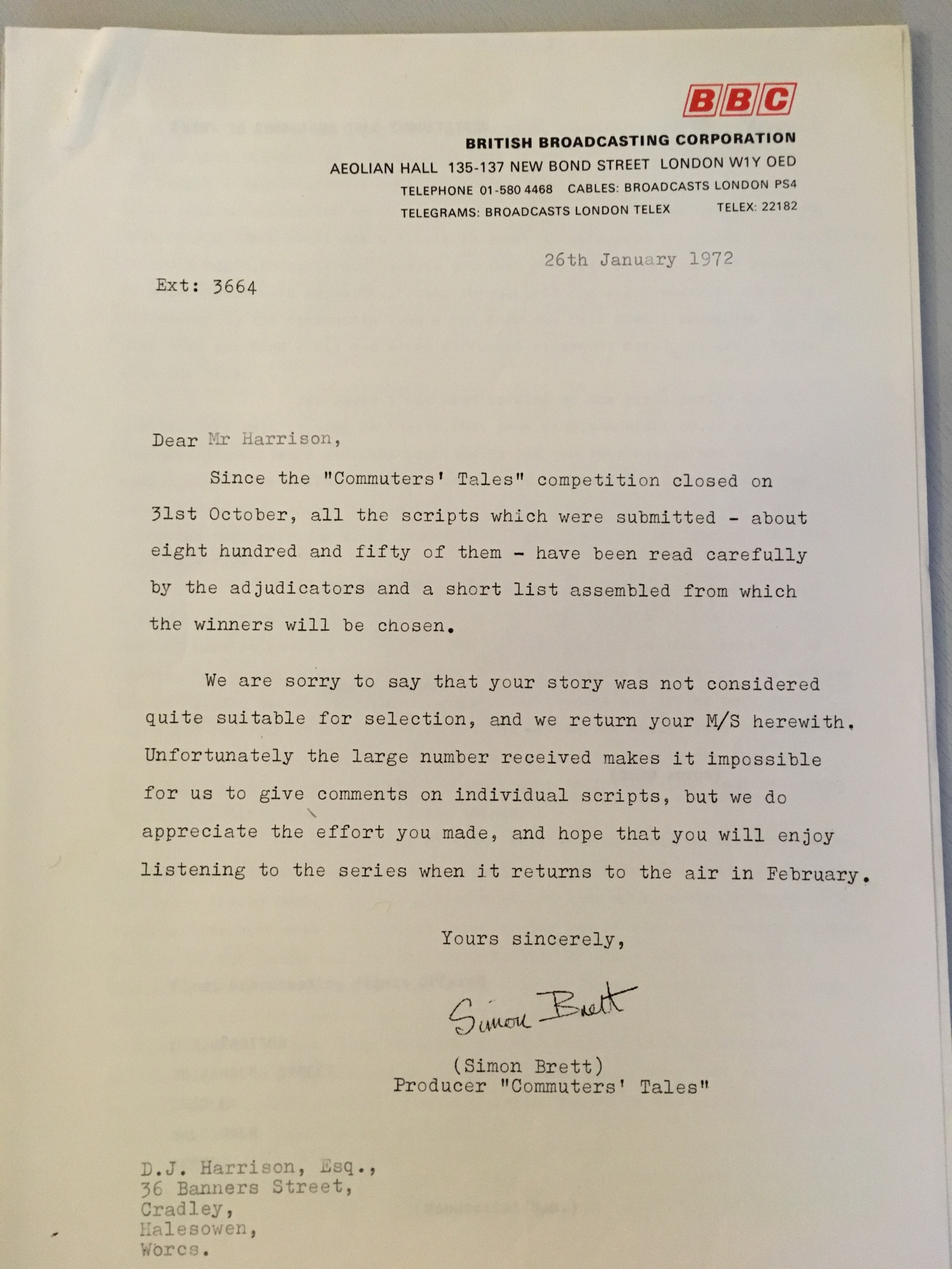
This is the result of the previous submission I made to the BBC. Note the date. January 1972. It's taken me this long to recover from the feeling of disappointment. OK, I suppose I'm not quite there yet.
In 1972, submitting a script was much more difficult than it is today. There were no computers, printers, photocopiers, email, internet or automatic spell checks. I had to type out my manuscript on a typewriter, a process akin to carving out letters on to tablets of stone. Mistakes were impossible to correct. They hadn't even invented Tippex in those days.
The kindest thing I can say about my 1972 submission was that it was typed reasonably neatly.
I'm now used to working with an editor, as you will have gathered from previous posts. I love the freedom this gives my novel writing. I am relieved from having to guess what works and what doesn't. An editor tells me in no uncertain terms. I'm more happy to accept criticism these days now that I recognise it as an essential part of my writing process. You note I use the term more happy and not just happy.
I've (bravely) put the BBC disappointment behind me and have sent them another script, 55 years on from the first (and only) one. This temerity has to be laid at the doorstep of that distinguished Irish writer and friend, Daragh O' Reilly. He's developed a bee in his bonnet about radio plays and, just so that I can spend some time with him, I joined him on a course about them. I've always been a big fan of Radio 4  and the prospect of getting something out on the airwaves is a delicious one however remote the possibility might be. Writing for radio is very different to writing a novel. My story arcs tend to be vast, requiring several hundred thousand words to complete. I write novels in batches of three or four. A 45 minute radio play needs only about 7,500 words. This is all a bit sudden for my liking so I've submitted the first episode of a six-part series.
I need to get back to the third Tyrant book now, but, before I do, I'll finish a new radio play that I've started . Then Daragh and I have a joint one to complete. Maybe I'm catching some of what he's got.

26 November 2016

Inspiration


As Stephen King will tell you, writers rarely ask each other where they get their inspiration from because we don't know. The more we think about it, the weirder it becomes, so we tend to take it for granted that the ideas will flow.
Some of us find inspiration comes more easily than others. There's this horrible thing called writers' block that gets in the way some times.
I'm very fortunate to have worked with the brilliant and insightful Barbara Turner-Vessalago for many years now. She has taught me the process that I use whenever I write. It doesn't matter what I'm writing, this really works for me.
Most of the time, I'm writing a novel. I used to think that a novel was an enormous almost never-ending task. I was often so daunted by the immensity of it I would feel like giving up. Then I learned that any piece of writing has to be written one word at a time. One word isn't so difficult to do. The next one comes even easier than the first and I'm away.
My starting point is almost always a place into which I parachute my characters and allow them to have a good look around. Then I see what happens and write it down.
Barbara's writing process is called Freefall and I heartily recommend it to you. I have found that most books on writing craft only become useful when I've more or less finished what I'm writing and am looking for technical assistance to make it work. Freefall is so wonderful because it gets me going. Starts me off. I lower my self into a time and place, sniff the air, listen to the rustling of the wind in the trees, narrow my eyes against the setting sun and...
I think you've got the picture.
Until recently, the only access to Barbara has been through her workshops in Canada, Australia and two per year in the UK. I'm lucky in that I've managed to attend at least one a year since 2007. Now, she has published two books on Freefall. Get them. You will find them useful and inspiring.

https://www.amazon.co.uk/Writing-Without-Parachute-Art-Freefall/dp/1908363045/

https://www.amazon.co.uk/Freefall-into-Fiction-Finding-Form/dp/178592172X/

At the moment, I have the fourth Jenny Parker novel away for copy edit. The two Tyrant fantasy novels are sitting in a proverbial drawer maturing and my SF novel, Voyager, has just reached the 30,000 word hump which means it's now got a life of its own and all I have to do is watch what happens and write it down. So I've taken a couple of weeks out to write a radio play. This is really good fun and a complete change to my usual form. As a prelude, I attended an inspirational one-day course presented by a radio producer called Polly Thomas. If I like what I produce, I'm going to actually submit the script to the BBC, who sent me the only rejection letter of my career in 1972.
Wish me luck.


photo credit: SFB579 Namaste Candle-Light via photopin (license)

14 November 2016

How the universe works


Ever wondered what makes everything the way it is? As far as I can make out there's just one fundamental law that governs everything, it's called the Second Law of Thermodynamics. This states simply that the entropy of any system always increases.

So there you have it. That's all you really need to know to understand how the universe works.

I could stop writing now but I won't. It may be that one or two of you would like an illustration of what the Second Law means.

OK, here goes. If you put a drop of ink in a pool of water, the ink will spread out until the pool is a very light shade of blue. That's the Second Law in action. It may seem innocuous and a bit obvious but it really does have huge significance. Let's take another example. Drop a sugar cube into a cup of hot coffee. The sugar cube disappears because the sugar dissolves. No big deal, you might say. But, consider this. NO MATTER HOW LONG YOU WAIT THE SUGAR CUBE ISN'T COMING BACK.

The diffusion and the dissolving are not reversible. That's entropy for you.

Another word for entropy is chaos. The world we live in moves inevitably from order into chaos. There's nothing we can do about it. The Law is the Law.

It may be that we experience time the way we do because of entropy. Without entropy, time could go either way. It wouldn't matter if it went backwards or forwards. The drop of ink coalescing in the midst of clean water would be just as likely a state as any other. But it's not. The way I see it, the Second Law ensures that time only moves forwards for us, never back. Which is a pity because I've just sent my two main characters in the SF novel I'm writing back to 1977. I'm struggling to come up with an alternative theory that circumvents the Second Law. Any help would be appreciated.

So, if the universe is a cup of coffee and we are grains of sugar, we know what's going to happen to all of us at some time. We'll dissolve away, lose our individuality and become part of the coffee.

The least we can do is to make the universe a tiny bit sweeter.


photo credit: only alice descent via photopin (license)

9 November 2016

Nanowrimo


It's November and time for the horribly named Nanowrimo which provides encouragement for writers to get down and write like hell for a month. 50,000 words is the target and it takes daily dedication in order to achieve it.
I've often referred to the desirability of a daily writing habit and how writing just a little bit every day can accumulate into a major work like a novel. I write about an hour or so most days, sometimes much more but rarely much less. This gives me an output approaching Nanowrimo proportions most months of the year.
As you can see from the banner, I entered Nanowrimo in 2014. I did this specifically to write the fourth Jenny Parker thriller when I'd already committed myself to a fantasy trilogy and a SF novel. It wasn't going to get done otherwise.
The reason for telling you this is twofold. First, if you need an excuse to write every day, a word count objective can be helpful. Secondly, I want to describe what happened to my script after Nanowrimo.
The first draft of Exit Strategy, as it has become titled, was actually 90,000 words and was written during October, November and December 2014. I then put it in a virtual drawer and carried on with my fantasy novels. In the middle of 2015, I went back to it and tidied it up so that I could send it to my editor. She did her work and issued me with her usual very detailed and perceptive structural edit. This provided the basis of a rewrite, which I completed in May 2016 and called the second draft. This went back to my editor and she provided another detailed report which was used to create a third draft which I sent her in September 2016. This third draft, notably, included a new beginning, a new ending and several injections of pace into the middle. It also changed much of the plot. In other words, draft three was a very different novel to draft one. A much better one in fact.
Draft three was submitted to my editor and she marked up all the areas that needed attention in order to maintain consistency. Draft four was produced a couple of days ago and has now gone back to my editor for a line edit. Up to now, all the editing has concentrated on plot and structure. Now I've established what I'm writing about, we can start working on how it's been written. The line edit will smooth over the words so that my readers can enjoy the story without being constantly dragged out of it by clunky expressions.
I expect the line edit to be done by the end of this year. Then I'll have to go through it and make the changes necessary before the final process, proofreading, is done. Proofreading clears up glitches, typos, formatting inconsistencies and that kind of thing. Once that's done, Exit Strategy can be published.
In summary, I finished 'writing' Exit Strategy at the end of 2014 and expect it to be published in early 2017.
Many people do Nanowrimo and self publish immediately. If I had done that, you'd be getting something quite awful, virtually unreadable and certainly not worth your time.
After two more years of work, Exit Strategy will be the best it can be. And I can be proud of that.

Pageviews