Showing posts with label Amazon. Show all posts

7 February 2022

Are you robbing me?

                                       Free!

Free books.

Why on earth would I give away my work?

Bear in mind it took me about seven years to get the Secret of the Scroll from conception to publication. During that period I rewrote it three times and added a second and third book. A conservative estimate of my time would be at least 700 hours. At minimum wage rates that would amount to £7000.

The there's the external costs of making the book fit to read. Editing included several passes of structural, a line edit and two lots of proofreading. The people I use are professionals and have to be paid accordingly. No change out of £2000 for that.

Then there's the cover, formatting etc. Another £500.

Total around £10,000 if you include my time, which, if you ask me, is very much undervalued.

But you can have the product for nothing. How can I justify that?

It's all about visibility. If I do the maths, I need to sell about 5,000 ebooks at £2.99 in order to break even.

That's not going to happen unless readers know my book is available and that it's quite wonderful. That's where my free promotion comes in. Think of Netflix. There, all the films are free once you've paid the subscription. So giving one a try for 20mins is painless and easy. If it's unwatchable, you've lost nothing but 20 mins of your time.

So, my resistance to renting an unknown film for £2.99 is far greater than trying it on Netflix. I can still feel the stinging disappointment of the ones that turned out to be a waste of money.

If you take my book for free, you will be doing me a big favour. This is how:

1. You move me up the charts. After 1 day of my free promotion the Secret of the Scroll is No. 1 in Epic Fantasy. That means more people get to see it.

2. You give me a chance to hook you with my writing. 

3. If you read my book you might leave a rating or review. Ratings are massively important for Amazon sales. Ratings also help qualify for the book promotion services with the greatest reach. Until I get 50 reviews, I'm practically invisible.

4. Most importantly, though, you might read my book. Which is the main purpose of writing it. Forget about economics, all I really want is to be read and enjoyed.

So, you're not robbing me. There's not need to wait for the price to go up. Be my guest, take a free book now and I hope you enjoy it.

27 September 2021

What's in a Name?


People sometimes ask me what on earth I was thinking when I named my son David John, exactly the same name as mine. I reply that I was expecting him to be a girl. That I was taken by surprise. That I panicked when I realised Samantha wouldn't be appropriate.

My decision has caused minor confusion for a long time but the situation recently changed with the publication of his first novel. He calls himself David J Harrison, not to be confused with D J Harrison, which is me. Phew! So that's OK.

His book, Recursion, comes out very soon and you should buy it so that you can see just how brilliant a writer he has become. I would like to claim some credit for his awesomeness but I won't.

Recursion


29 October 2020

Reviews Part Two


For years, my first Jenny Parker novel struggled to get reviews. There were a fair number of sales, but reviews were hard to come by. Then I wrote the blog previous to this one.

Unbeknown to me, my publishers had created a big promotion for the Jenny Parker series around the same time.

Normally, my sales are communicated to me with my royalty statement on a six monthly basis. A very good half-year might involve a thousand sales. I'd not had a good one for quite a long time. We're talking a few dozen sales.

I went to an old friend's farm to give him my rescue chickens. This isn't a digression, though it might sound like me going off at a tangent, because his partner and her friend have been keen readers of my books for years. A socially distanced chat revealed that she hadn't read the latest Jenny Parker book and she rang her friend to tell her there was another treat coming her way. I offered to send her a copy but she said she was happy to buy one.

OK, I'm getting to the point. Be patient.

If I want to see how my books are doing, I go to my Amazon author's page and look at the charts. One sale makes a big difference when you're selling very few books. You can soar from number 1,000,000 to number 50,000 in an instant before gradually decaying back down to earth.

On a promise of a sale, I checked my Amazon page. All my books were doing ridiculously well. Due Diligence was second overall in the UK and 3rd overall in the US. Obviously there was a glitch with the figures so I checked with my publishers. No glitch, more than 30,000 downloads, they said.

I was gobsmacked and happy. Then the sales persisted. Then the reviews and ratings began to accumulate. DD has well over a hundred positive reviews now.

So, I'm telling you that writers should never give up. Success can come at any time. And when it does, I have to remind myself to taste the sweetness instead of wishing for even more.

One sale is enough to make me happy. One positive review increases that happiness tenfold.

Despite the pandemic, there's a big smile on my face most of the time now.


30 December 2018

New Year


Happy New Year!

Here are a few tips that might help make 2019 a good writing year.

1. Write

Seems obvious, doesn't it? However, by waiting for the right time and perfect conditions I wasted many years of opportunity. Write a little bit every day. This is hard, I know, but it can be done.

2. Don't Edit

Write the piece in its entirety without going back over it and making changes. Finish it. This is even harder than number 1.

3. Write something else

This is the advice I give to anyone who sends me their work. A finished piece is best put away for a while before trying to assess it.

4. Don't Self-Publish the first thing you write

I know that intense feeling of temptation to upload my novel as soon as I've finished it. After all, if people can't buy it how do I become the next J K Rowling?
I was fortunate to avoid this catastrophic error and my writing career was saved. Anyone trying to read the first novels I wrote would have avoided me like the plague for the rest of time. And been quite right in doing so.

5. Just because it's been written doesn't mean anyone should read it

Believe it or not, this is a liberating thing. I avoid 'writing for publication' and write for myself. Always. Or at least I try not to second guess what the public might like because I have absolutely no idea. I do, however, know what I like. Write the book you want to read.

6. If you do publish, do it properly

There will come a time, I hope, when you've produced something you think might be of interest to a wider public. When that time comes, it is important to present it in readable form. In other words, it will need a professional edit. This will cost money. A lot of money in writing terms. Almost certainly more money than you will ever recoup in sales.

7. Writing is not a competitive sport

Any success I've had has been dependant on help from other writers. The writing community is a wonderful resource. Join it in whichever guise suits you. Your local writers' group is a wonderful place to begin.


photo credit: Sworldguy Fireworks Explosion via photopin (license)

21 October 2018

Unruly Chracters


As you might already be aware, I try to write a bit every day. I wake up in the morning and find myself enveloped in the story. I look around and see the characters who then begin to do things. Sometimes unexpected things. Unintentioned things. Exciting things. That's what makes writing so interesting for me. It's the not knowing.

When I get almost to the end of a story and realise what's going to happen, it becomes more of a struggle to write. It's as if my mind has finished with the project and is no longer interested.

I have been a little bit poorly of late and unable to write. Now I'm recovered and back at it, I find that my characters haven't had the patience and good grace to hang around and wait for me. Instead, they seem to have carried on regardless and what was a nice linear plot line involving four of them in a voyage of discovery has fallen to bits. I left them all on a perfectly good ship complete with crew, provisions and a clear plan. On my return, I find the ship is gone. I have no idea where it is. One of my characters is sitting on the shore feeling sorry for himself. Two more are wandering around in a jungle when they should be on the ship. These are the least of my problems. My fourth character has disappeared completely.

You might think it would be easy to find her. I'm the writer, after all. The fantasy world I've created is a bit short of detail, though. I only know about the places my characters have actually been. She may have gone somewhere new. Or even hopped out of this particular version of reality into a completely different one. She can do things like that. She's a witch.

OK, I'm currently writing fantasy but my process is the same for my crime thrillers. I'm with the reader all the way. I know what they know. I can speculate, just as they can, and I do this in the same way whether I'm writing or reading someone else's story.

Another thing I should mention is that my characters appear fully formed. What I mean is they have lived their lives outside the confines of my story and their motivation derives from experiences I have no knowledge of. Usually, I get to understand them better as the story unfolds. That's what makes them interesting.

Like my witch. After 250,000 words of the story, I'm at last beginning to understand the reasons behind her behaviour right at the beginning. What she did then is only now beginning to make sense.

Are writers supposed to carefully design characters down the the colour of their eyes and the toys they received for their first Christmas? Should they always know what's going to happen at the end of their story? 

Am I the only one who writes without knowing anything?


photo credit: Jrwn Photography Natcha via photopin (license)

22 September 2018

Science Fiction


Science Fiction is my favourite genre. I'd love to write a really good SF novel. Better still, I am going to write a brilliant SF novel, you just wait and see.

As a child, I would be taken to Tyldesley library every Saturday morning where I would gather my stock of books to last me a whole week. I can't remember how many I was allowed to borrow at a time but however many it was, it was never enough. Which meant that I had to read everything I borrowed. This was a very good discipline because it prevented me from falling into the habit of abandoning books without giving them a chance. Just like my Friday evening visits to the cinema, I made the best of what was on offer.

My go to books were the bright yellow sleeved Gollancz ones. I worked my way through them from Aldiss to Zelazny. Two particular favourites that I remember were Samuel R Delany and Theodore Sturgeon. Happy days.

I also like Fantasy. Traditionally, Fantasy involves swords, elves, dragons and similar things whereas SF has spaceships, robots and technology. Many of these are interchangeable but the defining element is often said to be magic.

The problem with magic is that it has to be carefully defined for it to be a useful plot element. It's too tempting for a writer to suddenly conjure up a new piece of magic to help his protagonist out of a tight spot. That kind of behaviour plays havoc with dramatic tension and has the reader relaxed and waiting for a new miracle at every crisis point.

The SF equivalent is, of course, technology. Star Trek provides plenty of wonderful example of how not to use technology in a story. Suddenly deciding that reversing the dilithium crystal polarity to  save the Enterprise from doom can be a bit weak unless you've tried it at least once before and shown the reader or viewer some potential negative consequences.

It's easy to be lazy when you're inventing your own technology or dreaming up magic spells. That's why I think that the very best of both genres ranks with the very best writing ever. I also recognise that the opposite is undoubtedly true.

The most recent SF book I read was Dogs of War by Adrian Tchaikovsky. It's superb. Highly recommended, as is his Nebula Award winning Children of Time. One of my all time favourite SF reads is the Algebraist by Iain M Banks, though every book he wrote contains much to savour.

As for Fantasy, it's hard to look beyond the Hobbit. Some might say this is the book that shaped the genre for all time. However, I can't not mention Joe Abercrombie and the First Law series. Joe is in a different class entirely to every other Fantasy author.

So, one day I'll have my own masterpiece to add to the pantheon of SF. All I have to do now is to write it and convince Gollancz to publish it.

Watch this space.


photo credit: jaci XIII New family via photopin (license)

15 September 2018

Taking Stock


On the day that my second Jenny Parker crime thriller is published by Endeavour Media, I am taking stock of where my writing is up to.

The third Jenny Parker, Limited Liability, is scheduled for publication in October. The fourth, Exit Strategy, is done and dusted. Written, revised (many times), edited, rewritten, edited, finalised and copy-edited. Polished to a burnished hue. Ready to go.

I'm currently writing a fantasy series. Three books. The first two are drafted. I've already completely re-written the first after feedback from an agent and it's much better. The third Tyrant book is well under way.

The rest of my recent output is looking for an agent that can get the best out of it.

A stand alone novel about a father-daughter dysfunctional relationship.

A novel based on the early years of my waste management consultancy.

Two Palmer and Jones books (humorous crime novels).

A childrens book, Unipig.

A toddlers book (Not for Bedtime).

A book about the ancients gods of Sumeria (in process).

Then there's my SF trilogy, Technical Difficulties. I wrote these around ten years ago. All I can say about them is that they were good practice for the discipline of writing. They will never see the light of day. At least not in their present form. I've started a rewrite, of course I have, but it's got bogged down in 1977 Las Vegas. Not the best place to leave your characters.

Now I need someone to look at all this stuff and help me decide where to concentrate my efforts. Meanwhile, I write what comes up and there's plenty that is.

5 August 2018

The Ten Minute Rule


Give it ten minutes.

It's a symptom of the modern age that we have less and less attention span. The situation hasn't been helped by the advent of streaming. We can get movies and books instantly. If we don't like the one we're watching or reading, we can change at the prod of a finger.

Once upon a time, I used to have to go down to the local Blockbuster video store and physically borrow a copy of a film. An even longer time ago, I would go to the library every Saturday morning for my weekly ration of reading matter.

Either way, movies or books, I was stuck with the selection I'd made. If the film was rubbish, I'd watch it anyway because I'd taken ages to choose it, queued up to rent it, paid for it and driven there and back. And there wasn't anything else for us to watch. If the book I'd borrowed was a bit dry, I'd read it anyway.

Now I have Netflix and Amazon and iPlayer and Kindle and iBooks. If what I'm reading or watching isn't doing it for me, it's liable to get replaced by something else. Instantly.

That's what I call the ten minute rule. Sometimes ten minutes is being over-generous with my time. A good film has me forgetting that I'd decided to give it ten minutes because I get absorbed.

As a writer, I feel compelled to give books a bit more room to impress me. A slow start doesn't necessarily mean a bad book. However, I'm conscious that many readers these days aren't so patient. Books are chosen on the basis of the cover and then the first few sentences. Quite honestly, I'd be happy if readers would give my books a whole ten minutes.

Which makes it incredibly satisfying when people do read my books from cover to cover. My publishers recently promoted my first Jenny Parker thriller in Australia and we sold lots of copies. What was most exciting, though, was the number of people that bought and read the other two in the series. Unless I'm deluding myself, these wonderfully astute readers must have enjoyed their first taste of Jenny Parker to be willing to pay for more. Nothing could be more satisfying for an author like me.

Having said that, I'm constantly aware of the need to make my books as instantly compelling as possible. There's no room for shilly-shallying about in the modern novel.

The ten minute rule sees to that.


photo credit: marcoverch In letzter Minute via photopin (license)

29 July 2018

Violence


I love a good thriller and thrillers usually involve violence. What I don't like is the portrayal of violence as the universal answer to any problem. If I read a book or watch a film that uses violence to sort the job out, I feel cheated. I think of it as lazy and unimaginative writing.
Violence creates problems, it doesn't solve them.
Take a comment I once saw posted on the Glock website. (For those of you who don't have an interest in handguns, I will explain. Glock make pistols that are the weapon of choice for many law enforcement agencies. British police use them, for example.) A customer asked why the Glock 19 only held fifteen bullets in its magazine. The answer was a good one. If fifteen rounds from a Glock hasn't solved your problem then maybe you chose the wrong solution.
My complaint is that books and films choose the Glock solution too often when it is inappropriate and unsatisfactory.
Most of us don't have the option to visit violent retribution on evildoers. As any sane American will testify, nor does having a gun protect you. (Unless someone shoots you and the bullet hits your gun and bounces off, I suppose)
My protagonist in Due Diligence, Jenny Parker, is an ordinary person. She's just like you and I. Vulnerable. No institution to back her up. She doesn't have the option to fight fire with fire. That would not only get her arrested. It would be also be pointless and ineffective. She has to find other ways to survive. She has to use her wits.
I find that so much more satisfying to write and to read.
As for the magazine capacity of a Glock 19, I find it hard to stuff more than ten rounds into the magazine before the spring gets too stiff for my thumb.
(I hasten to add that my experience of handguns has been limited to a legal range in the US while conducting research. Sometimes it's necessary to obtain first hand experience even if you disapprove of what you're trying out.)


photo credit: subtlemd CZ 85B 9mm via photopin (license)

4 July 2018

You're a Writer, So Admit It!


I know that this blog is supposed to be about writing but the film ‘Patrick’ does have some relevance, so bear with me.

While on the subject of Patrick, I urge you to watch it. Take the whole family. Believe me you’ll enjoy it, perhaps in spite of many misgivings. It’s a brilliantly gentle British comedy in the best tradition of all that’s good in that genre. The sort of film that amuses, entertains and leaves you feeling uplifted.

As I said though, this isn’t a film review column, it’s about writing. So where’s the relevance?

Here it is.

I have found that I possess an inherent reluctance to admit that I’m a writer. I don’t think that I’m alone in this feeling. Perhaps it’s a fear of being harshly judged. The response to an admission is usually something along the lines of ‘Oh, really? Have I heard of you?’ or ‘Are you as good as Stephen King and have you sold as many books as J K Rowling?’ At least that’s what I hear, even if the actual words are less specific.

While on holiday in cloudy Dorset, escaping the rigours of the harsh Lancashire sunshine, I met a lady who said she was a writer. I plucked up the courage to admit that I was also a writer. She told me she wrote films. I said I wrote crime thrillers. I told her my name and she went away and bought Due Diligence, the first Jenny Parker book. Next time I saw her, she told me she was reading it and enjoying it. Then she invited my wife and I to a special showing of her latest film, Patrick, where she introduced the leading lady to an audience of her friends. It was a very good evening and talking to her has given me a valuable insight into the film world.

I’m not implying that Jenny Parker is going to be gracing the silver screen any time soon but I’m very glad I admitted I was a writer because otherwise I wouldn’t have made this exciting connection.


It takes courage to admit you’re a writer, I know it does. It takes even more courage to engage with other writers but I strongly advise you to do it. I'm a member of my local writers' group and this has been an enormous support to me from my first tentative attempts at writing to becoming published. 

Meanwhile, enjoy the movie.

12 May 2018

An elephant with two trunks

Let's have a referendum.

I think that all elephants should have two trunks. How about you? Wouldn't that be a really cool thing. Good for the elephant, I bet. And good for the zoo visitor who will be able to see something different. Imagine the benefits of two trunks. Breathing while drinking. The ability to pick up two things at a time. It seems a shame that they have been denied the extra trunk for so long.

I'm convinced that having two trunks would be a major benefit for both elephants and humans. Don't you agree?

So, let's vote on it. We can have a referendum. Sort this out once and for all.

Sounds crazy, doesn't it? The idea that just because people vote for something then it has to be like that. You and I know perfectly well that no matter how overwhelming the vote might be, elephants only have one trunk and that's that. The vote changes nothing. All it does is make us look stupid and ill-informed for bothering.

The Brexit referendum is pretty much the same. People (narrowly) voted for two trunks. They were promised two trunks by politicians who didn't have any prospect of delivering.

Now, the reality of EU membership is starting to become clear. It's a club we can't leave. We are in Europe and, no matter how many people vote to be somewhere else, that's where we stay. Our major trading partners are European. Our food supplies come from Europe. Our defence strategy is European. And so on.

The big shout from the Leave campaigners is that the people have spoken The will of the people must be done. We have to leave the EU. Elephants must have two trunks.

The Government has recently realised that elephants only have one trunk and that there's nothing they can do to change it.  Two isn't possible but none certainly is. If they can chop off the trunk of every elephant then at least they will have done something in response to the referendum.The elephants will all die but that's merely the consequence of holding a referendum that demands a change in the number of trunks an elephant should have.

It's the will of the people that elephants must have two trunks. They voted for something that isn't possible. Even another vote that promises three extra trunks per animal wouldn't change the facts.

It's the same with the EU. Voting for things to be different doesn't change the fact that we rely on our EU membership for our livelihoods.

But, the people have spoken and cutting off our only trunk might be the only alternative to leaving things as they are.


photo credit: marfis75 Elefantastisch. via photopin (license)

6 May 2018

First Draft


OK, so you've written a story. Now what?
Read it out loud, either to yourself or some poor soul that hasn’t anything better to do with their time.
This will give you an idea of what works and what doesn’t. A word of warning, if it’s your first novel then very little of it will be salvageable. Best not to try.
I thought my first novel was a humdinger. A work of brilliant wit and master storytelling. Fortunately I paid someone to tell me different.
It wasn’t until I finished my fourth book that I had something that had the potential to be read.  Then I made a big mistake. This was Due Diligence, my first Jenny Parker novel. I’d just finished writing it and was introduced to the crime fiction editor at Orion. He said he’d read it if I sent it to him. On the train coming back from London, I pressed the send button. I wish I hadn’t.
It taught me never to send out or publish a first draft. I never heard from him again and no wonder. The book began with Jenny on the toilet!! What was I thinking? The final version (two years and several versions later) had none of that in it and started what had been halfway through.
You only get one chance to impress a publisher or a reader. If you blow it, that’s them gone for ever. For ever. Think about it. If you started to read a book by D J Harrison and it was an unreadable stinker, would you be likely to seek out one of his later books and give him another chance? No? Of course you wouldn’t.
Publishing a first draft is always a mistake. Always.
What do I mean by a first draft? Well, you’ve written it, put it away, read it out loud and revised it. Then it’s a first draft. 
When you can’t make it any better yourself you need an editor.
Believe me, you can’t edit your own work. It’s impossible. I’ve tried. There’s a blindness that afflicts a writer when reading their own work. After all, you know what you meant to say. You know all about the characters. You know everything. It’s impossible to be objective.
A good editor costs money but is an essential investment. Before you commit to that expense, I suggest that you pay for a critique. This will help to convince you that your novel is worth further time and attention. Or it might not. Both messages should be heeded. Especially the second one.
I think of my novels as ships. If someone looks at the whole vessel and decides that it’s ugly and unserviceable, there’s no point in my redecorating the captain’s quarters and hoping that will make things right, is there?
What about money, though? I already told you that editors cost money. But how much should you pay? Editors are a bit like lawyers. There’s nobody more expensive than a cheap lawyer, in my experience. Scrimp on the editor and you’ll end up with a shoddy book.

photo credit: Mark van Laere Creativity via photopin (license)

29 April 2018

Writing Tips


Someone has asked me to write down my writing tips. So I have.
My first tip is: Write
            This is so bloody obvious it shouldn’t need saying. But it does. It took me ages to realise that’s what I needed to do.
            For years, I wrote very little, preferring instead to prepare for that wonderful day when I would be free from all encumbrances, released form inhibitions and have the swathes of time I needed to write.
            Poppycock. Baloney.
            This was self-sabotage of the worst kind.
            A writer needs to write. The thing that has helped me more than anything has been the development of a writing habit. This began when I managed to persuade myself that writing was more important than watching Coronation Street. As soon as the theme music started, I left the room, went to my quiet place and sat down to write. My wife and family became used to it. They were distracted by the TV and I claimed an hour or so of peace. This was my big breakthrough. I ‘came out’ as a writer as a result. I became a writer at last.
            Now, my practice has shifted to early morning but remains an overt one. My wife doesn’t expect to see or hear from me until about 11am. By which time I have done my writing for the day.
            Writing every day is good for my soul. It provides me with nourishment and contentment. On days when I can’t write, the ensuing day seems to have less sparkle.
            However, if I don’t write, I’m gentle with myself.
            Writing every day (or most of them) brings another benefit. Productivity. A morning’s writing can produce a thousand words. If I do that every day, we’re talking about three hundred thousand words in a year. Five hundred words a day would still produce the raw material for two or three novels.
            The maths are compelling if you write every day. Two hundred and fifty words, a page, accumulate nicely to a novel a year proportions.
            It’s doing it every day that makes this possible.
Quite honestly, I couldn’t write any more than I do. Writing is hard work. Exhausting work, physically, mentally and, if you’re having a good day, emotionally.
My advice is to write, then. Whatever you’re writing, write until you’ve finished it. Don’t look back. Don’t try to judge it. Resist the urge to throw it all in the bin.
Put it away for a while. Some like a month, me, I prefer a year.

photo credit: Brett Jordan Word (lock) via photopin (license)

20 February 2018

Freefall Writing


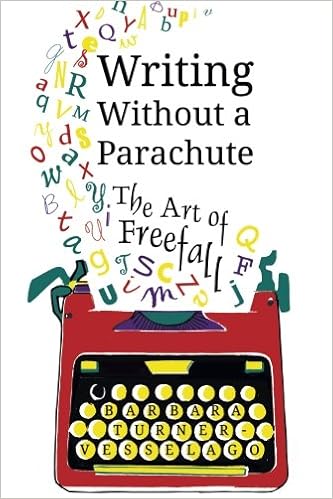
https://www.amazon.co.uk/Writing-Without-Parachute-Barbara-Turner-Vesselago/dp/1785921711/

No matter how long I've been writing, there's always more for me to learn. Reading other writer's work is a brilliant way to do that. Writing itself, just putting words on paper is also recommended. However, a school teacher once told me that practice did NOT make perfect. 'If you carry on making the same basic errors, you'll never improve. CORRECT PRACTICE makes perfect' is how he expressed it.
With that in mind, though they say you shouldn't take any notice of school teachers because 'those who can, do and those that can't, teach,' I try to take every opportunity to improve my writing technique.
Content isn't a problem for me. I'm blessed with a very inventive mind that is harder to rein back than it is to get going. Getting it down on paper in a manner that will keep a reader engeged is the trick as far as I'm concerned.
Many years ago, I was introduced to Barbara Turner-Vessalago's Freefall writing method and I've been attending her two UK workshops every year since.
My first attempts at novel writing are the stuff of legend. I wrote a SF trilogy with a casual, stand-offish point of view that was packed with self-conscious humour that didn't work and served only to dissipate what little dramatic tension I'd created.
Barbara taught me to write from a more authentic place. To embody what I was saying. To feel in to the characters and the situation. To drop into a place, look around, see what was happening, smell the air, listen to the wind in the trees, watch my characters react to their surroundings.
Her workshops are wonderfully transformative. She is a supremely gifted mentor and the feedback she gives is always exactly what is needed. Unfortunately, there are only two courses per year in the UK and only twelve writers per workshop. Of the twenty four potential places, though, at least half are taken up by gluttons like myself. So the opportunities to attend are very limited. If you ever get a chance, I advise you to take it because you won't regret it.
After much heart-searching, Barbara distilled her teaching into a book which provides a very cost-effective alternative to her workshops and is the next best thing.
With Barbara's blessing, I'm going to be giving a short introductory workshop to Chorley and District Writers' Circle on February 27th. Check out  http://www.chorleywriters.org.uk/ if you're interested.
If you can't make it, get the book.

13 February 2018

Chekhov's Gun


My wife had trouble sleeping and discovered that not watching the TV (or any other kind of screen) in the evening made a positive difference. It has also helped me.
In the absence of television to amuse us, we turned to reading together. A good book is a very rewarding shared experience. Even better, we find, is reading aloud. Most nights, therefore, I read to my wife who sits on the sofa in front of the fire with her knitting. We started with my books. It's important for me to hear what I've written because it helps me eliminate clunky bits and also adjust the rhythm of the sentences. Reading to someone else also has the advantage of giving the opportunity for feedback, a valuable resource for any writer.
My wife is particularly good at picking up things that don't work. Awkward sentences, inadequate explanations, lack of detail, that kind of thing. There's a good adage when it comes to feedback:
If someone tells you that a piece doesn't work they're almost always right.
My wife is getting very good at helping me put things right.
Reading makes me a better writer. Writing makes me a better reader. I think it works for everyone.
In the days before television, books were the main source of entertainment and delight. There was a time, not so long ago, where not everyone could read and being read to was a valuable experience. Before that, storytelling was a purely verbal craft. I find that reading to my wife is wonderfully intimate and connective. It's a joyful and rewarding experience that nothing televisual could ever match.
My wife doesn't only have to listen to my books, though. We both delight in reading other things. Recently we've completed Peter Hoeg's The Susan Effect and Philip Pullman's Book of Dust. Currently we're getting on well with The Paranormal Policeman by D J Harrison (which is yet another one of mine).
As a writer, I can appreciate the craft that goes into a good book. One of the things that I particularly watch out for is the principle of Chekhov's Gun. This convention insists that something introduced into a story, such as a gun, must be used. Otherwise there is an element of dissatisfaction for the reader that they might not even be consciously aware of. In the Susan Effect there's an actual gun hanging on the wall which is taken down, examined and put carefully back onto position. My experience tells me to watch out for it later on and sure enough, there it is, popping up at the end in a very satisfying conclusion. A popgun, you might say if you were a humorous writer.  I told my wife about Chekhov's gun. She's now on the lookout for more examples and says it makes reading (or listening) to stories even more enjoyable.
My editor once pointed out the way I was dangling items in front of my readers then never mentioning them ever again. She told me to cut it out, that it wasn't something a good writer ever did. I had to mention the Sternwood chauffeur in The Big Sleep (Marlowe never finds out who murdered him) but her justifiable reply was to the effect that if I ever became as proficient as Raymond Chandler then I could please myself. Until then, I'd be best advised to knuckle down and learn my craft.
That's what I'm doing and reading to my wife is a big part of that.


11 January 2018

Stranger then Fiction


Truth is stranger than fiction. This familiar saying is a quote from that master storyteller, Mark Twain. Any writer of fiction, like myself, has to bear this in mind.
Why?
Well, I suppose it's because too much realism can be difficult for a reader to swallow. Real life tends to be fragmented, things happen that are often completely unrelated. The relative importance of events can be very hard to judge and often remain opaque. Things come and go. Things that seemed to matter one moment fade into complete insignificance.
None of these aspects of reality are conducive to telling a good story. In fiction, it's essential to have a structure. A beginning, middle and end. There has to be a satisfactory outcome for the reader, something that can't be guaranteed by a factual account.
You might have observed that books, films and TV programmes based on true events are always heavily dramatised. The complexity of the real has to be simplified and carefully presented in order to tell a story in a way that will hold an audience. Outcomes, especially, are manipulated in order to deliver that essential happy ending.
Here's an example of what I'm trying to say. Consider this as the plot for a thriller.

The Russians invade Ukraine on a pretext. They arm the local thugs and support them with Russian soldiers who are 'on holiday' there. A Russian-supplied ground to air missile system is deployed to shoot down a civilian airliner and kill hundreds of innocent men, women and children. The AA battery is quickly spirited away back to Russia and vigorous denials are issued.

The CIA find satellite evidence of Russian involvement in the atrocity. Secret agents in Russia collect damning information about the incident and also uncover links between the Russian leader and organised crime. More diligent investigative work discovers billions of dollars of offshore funds linked directly to Putin.

OK, so far so good. Let's put an ending to it:

In a race against time, a plucky CIA agent puts all the information together and then manages to dash to the UN building, through a hail of FSB bullets, and give it to the US Ambassador. A Security Council resolution proposed by Russia is blocked when the revelations are made. Russian allies voice their disapproval and withdraw support. Hundreds of thousands of lives are saved in Syria as the disgraced Russian regime is prevented from continuing to support the vicious Assad regime. A popular uprising in Russia ousts the president and the world becomes a better and more peaceful place.

This is the kind of thing required to make a good story. Of course, it's fictional. The true outcome is as follows:

FIFA decide to hold the World Cup in Russia.

See what I mean?


photo credit: Delta_33 Malaysia Airlines 9M-MTC Airbus A330 via photopin (license)

24 November 2017

Growth


Stephen King considers The Shining to be his breakthrough novel. Instead of doing more of the same that had earned him fame and fortune, he consciously decided to make the Shining something more. The way he did it was to concentrate on the character of the father and his upbringing so that the demons that afflicted him later on in the book are as much internal ones as the result of supernatural forces. According to King, being propelled by some external irresistible force provides too much of a comfortable excuse and dilutes the power of the narrative.

I found this insight extremely valuable and it has changed the way in which I view my own writing. My crime fiction books are primarily plot driven. Fast paced, breathless even. I try to pack as much story into each paragraph as I can. There's nothing wrong with that. As Vonnegut advised, I try to spend  my reader's time as wisely as possible.

Lately, though, I've been working with my writing mentor on a project which is more an examination of character and relationships than whirlwind narrative. For me, it has been a completely new way of doing things. I'm a great proponent of the write the whole thing and don't look back until you've finished method. It has served me very well in the past and has the great merit of not having to make any judgements as I go along.

For this novel, and it's grown to novel proportions already, I'm constantly trying things out because I have the great benefit of someone I trust who can give me an opinion. There's been a lot of stuff that I've submitted which hasn't gone down at all well. Fortunately, I've sufficiently matured as a writer to view negative comments as even more valuable than positive ones. Sometimes I find it hard to agree with them but most of the time I'm able to reflect on the truth behind them and take them on board.

This has resulted in lots of rewrites, many versions of the same scene, drastic plot revisions galore. For example, an early version had the protagonist in a hospital bed paralysed apart from a couple of fingers on one hand which he used to type long accounts of early childhood. This might immediately seem cumbersome and overly melodramatic to you but it took me a while to get that myself.

I don't know if this will be my breakthrough novel and, quite honestly, it might not even see the light of publication. What matters is that I feel that I'm growing as a writer all the time and that's important.


photo credit: JoeInSouthernCA Vintage Movie Poster: "The Shining" via photopin (license)

11 August 2017

Washy-Wishy?


I saw this thing on the BBC website and loved it enough to want to tell you about it. As a writer, I love words and what they can do. I also recognise that years of practice have instilled in me some basic rules that serve me well. A writer's job is to tell a story and not to advertise the way in which the story's being told.
If I write a clumsy sentence, or even a single inappropriate word, the reader is immediately pulled out of the situation my protagonist is faced with and back to reality. Do that often and any reader will put down my book in disgust and give up. Having a compelling plot and interesting characters isn't enough. The story needs to flow in a way that a reader will find comfortable and satisfying.
There are many craft books out there that help a writer to understand what works and what doesn't. However, there are some extremely powerful rules that are instinctive and rarely expressed.
Take this, for instance:

Adjectives in English absolutely have to be in this order: opinion-size-age-shape-colour-origin-material-purpose Noun. So you can have a lovely little old rectangular green French silver whittling knife. But if you mess with that word order in the slightest you’ll sound like a maniac. It’s an odd thing that every English speaker uses that list, but almost none of us could write it out.
The Elements of Eloquence by Mark Forsyth

Break this rule and, as the man says, you'll sound like a maniac. Which will be off-putting to your English wonderful readership. ARRGH! See what he means?

Of course there's more too it, there always is. I can almost hear the cries of Big Bad Wolf. What about that then? Shouldn't it be Bad Big Wolf according to the rule, even though that would sound pretty awful?

The brilliant Mr Forsyth explains:

Reduplication in linguistics is when you repeat a word, sometimes with an altered consonant (lovey-dovey, fuddy-duddy, nitty-gritty), and sometimes with an altered vowel: bish-bash-bosh, ding-dang-dong. If there are three words then the order has to go I, A, O. If there are two words then the first is I and the second is either A or O. Mish-mash, chit-chat, dilly-dally, shilly-shally, tip top, hip-hop, flip-flop, tic tac, sing song, ding dong, King Kong, ping pong.

So linguistic reduplication is so important that it outranks the adjective sequence.

We don't have to learn any of this, it's all natural. Which makes it so powerful because my readers don't spot that I'm breaking any rules, they only know that it sounds wrong and they don't like it. So they stop reading. And I don't want that.

No more washy-wishy prose for me, I'm getting Mr Forsyth's book. 

https://www.amazon.co.uk/Elements-Eloquence-Perfect-English-Phrase/dp/1785781723/


17 July 2017

Is Kindle broken?


Amazon KDP has been good to me. Way back in 2013, Due Diligence made it into the top twenty crime thrillers and the overall top one hundred kindle charts. You can imagine how chuffed I was. I sold several thousand books in a very short time and all because Stephen Leather invited his readership to try it.

A few years down the line, services like BooksgoSocial and Bookbub will promote your book for a modest fee. They can be picky, though, as they depend on keeping faith with their readers and not fobbing off some rubbish on them. A lot like Stephen, who took the trouble to read the copy I sent him. Not like Stephen because he helped me for free, as he's helped lots of other writers.

Amazon, in order to promote their Prime membership, decided to offer free loans of books that were enrolled in KDP Select. At first they paid authors on the basis of downloads. Then they decided that this wasn't fair. Short books received the same payment as longer ones. It didn't matter if the books were read or not the author got paid regardless. Then Amazon decided to change the basis of payment. Every page read was recorded and totted up and the fund distributed accordingly. Seemed fair to most people at the time.

I quite liked it at first, I had a 'pages read' graph to go with my copies sold one. Some days, I'd pretend the pages read were the copies sold just to make me feel especially good. Then bad things started to happen. I got wind of authors' amazon accounts being removed because of anomalies in their page counts. One of my books took a leap skywards for no reason, thousands of page reads where there had been a steady few hundred before. I got cold feet and took all my books off Select. Losing your Amazon account is fatal for an author in these digital times and I realised that abuse of the new Amazon payment system was likely to become worse. I was right.

Recently, really awful books by unknown authors have been hitting the top of the Kindle charts. Books with very few and very bad reviews. They got their exposure and thousands of sales by what's known as clickfarming.

Clickfarming involves downloading the book hundreds of times and then employing someone to flick through each copy. Let's say a book is 200 pages. After each 200 page views are recorded, Amazon count it as a sale. Then the book is catapulted up the charts, people see it and they buy it.

Not only that, but the author is paid a share of the KU pot on the basis of every page read.

Some organisations offer this service to authors for a fee. Others take all the money themselves by uploading their own books, often computer generated or pirated.

In order to make it more difficult for Amazon to detect them, some clickfarms add some 'innocent' books to the ones they are pushing.

Amazon delete the accounts of anyone they suspect of clickfarming and this seems to have included authors who were completely unaware of what was going on. I've not heard of any successful appeals.

So, keep your eyes peeled, stay sharp and safeguard your precious account. If you're new to Kindle, think twice before enrolling in Select.


photo credit: ToGa Wanderings Free Internet via photopin (license)

4 July 2017

Publishing, self or otherwise

Writing


I was looking for an image that best represented much of my writing. This is stuff I had to write, stuff I enjoyed writing and stuff that helped me to get a better handle on the process of writing. All good stuff, as far as I'm concerned. Do people lie awake at nights longing to read this stuff?
No.
Neither would they thank me for offering it to them. In the unlikely event that they did read it, they would be mightily irritated. To the extent that they'd shun anything and everything I might show them in the future.
And I don't blame them. It's what I do.

Self-published books

This is an image representing self-published writing. The notice on the bin bag hasn't been edited or proof read, something that 99% of self-published writing has in common. Anyone that reads the label can see that what's inside is rubbish.

Write, by all means. Write as often and as long as you can. Write everything that comes into your head. But try to resist the impulse to publish it until you're absolutely sure it's the best thing to do.

Otherwise, when you do come up with something worth reading, any readership you might hope to attract has long ago written your name on their reading list and crossed it off with an indelible marker.

I was very fortunate. I wrote what I considered to be a cracking SF trilogy. Everyone who read it said it was awesome and brilliant. The problem was that my friends and family weren't professional writers and, worse still, are usually inclined to be kind to me. Neither of these factors was helpful in determining the merits of my novels. What I needed was an objective and knowledgeable opinion from someone used to giving one. A professional critique, to give it its proper title.

My first critique was very difficult to take. It took me years to get over my anger and disappointment but I did come to terms with it eventually. My writing got better, much better. I became conscious of things I do that get in the way of the story and learned to avoid them much of the time.When my first novel was published, I'd improved enough to tell a good story without annoying the hell out of most of my readers. This proved a good marketing ploy because many of the same readers went on to buy more of my work, which gets better all the time. As it should.


photo credit: Mink When will people start to recycle? via photopin (license)
photo credit: garryknight Heavy via photopin (license)

Pageviews