Showing posts with label David Harrison. Show all posts

27 September 2021

What's in a Name?


People sometimes ask me what on earth I was thinking when I named my son David John, exactly the same name as mine. I reply that I was expecting him to be a girl. That I was taken by surprise. That I panicked when I realised Samantha wouldn't be appropriate.

My decision has caused minor confusion for a long time but the situation recently changed with the publication of his first novel. He calls himself David J Harrison, not to be confused with D J Harrison, which is me. Phew! So that's OK.

His book, Recursion, comes out very soon and you should buy it so that you can see just how brilliant a writer he has become. I would like to claim some credit for his awesomeness but I won't.

Recursion


26 March 2018

Nowt on Telly


If you're like me, you've spent a fair amount of time watching things on TV that, in hindsight, seem a complete waste of time. Then you watch the next instalment if only to see if this one's any better than the last. Perhaps, as I have, you've become inexplicably hooked by a couple with more money than sense being filmed looking for a property in the country.
If I see one more undercooked rack of lamb on Masterchef I may throw up.
There's an antidote to the hollow feeling that comes from wasting an evening in front of the box. It might be hard to swallow for the first few attempts but it's well worth persevering. If you do, a whole new richness will enter your life. Every day will hold the promise of discovery and excitement. Life will feel that much more worthwhile.
There's a magical effect produced when a TV is switched off. Your attention becomes your property again. You can do with it whatever you wish without it being constantly dragged to the screen.
Then there's the silence. Opportunity for stillness. Your mind relaxes, free from a constant bombardment of images and sounds.
So what do you do instead? What's this magical alternative to relaxing in front of the telly?
Read a book.
It's the best antidote to boredom and that empty feeling of having wasted time.
Ok, I'm an author so I would say that, you might think. There he goes, trying to peddle his books, you might say.
In response, I admit that I'm as affected by TV in all its forms as anyone. I waste vast amounts of precious time slumped on a sofa in a semi-comatose state.
As soon as I pick up a book and start reading, I feel so much better. Reading is a much richer experience than TV can ever be.
I'll prove it to you, if you have any doubts. Read any book that has been adapted for TV, then watch the program or film. It's become a cliche that the book is always better than the film but this just isn't fair. A book is a book and a film is a film. They're different media. You can do things in books that films, even using the most sophisticated computer generated imagery, can't possibly display. The greatest actor on the planet can't hope to communicate feelings with the same intensity that living inside the character's head can.
Try Lord of the Rings, even if you've seen all the films.
Read The Handmaid's Tale, even if you saw the TV programme.
Read The Shining, then watch the film.
Read anything by Iain Banks, David Mitchell, Haruki Murakami, Neal Stephenson.
Why not try the greatest crime writer in the history of the world, Raymond Chandler? His books have been made into films again and again. The Big Sleep is a particular favourite of mine.
You don't even have to buy a book. We have a brilliant library service in Lancashire.
If you do want to make a purchase, support an independent book shop.
By the way, there's a TV adaptation of China Mieville's The City and the City coming on the BBC. Get the book. Immerse yourself. Then enjoy the program in a very different way.

20 February 2018

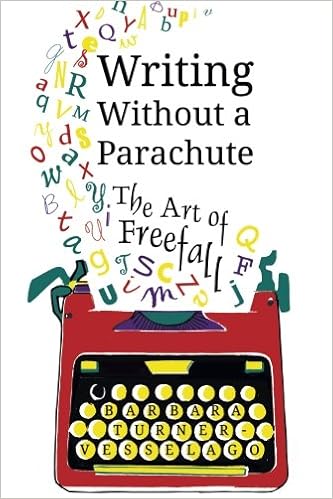
Freefall Writing


https://www.amazon.co.uk/Writing-Without-Parachute-Barbara-Turner-Vesselago/dp/1785921711/

No matter how long I've been writing, there's always more for me to learn. Reading other writer's work is a brilliant way to do that. Writing itself, just putting words on paper is also recommended. However, a school teacher once told me that practice did NOT make perfect. 'If you carry on making the same basic errors, you'll never improve. CORRECT PRACTICE makes perfect' is how he expressed it.
With that in mind, though they say you shouldn't take any notice of school teachers because 'those who can, do and those that can't, teach,' I try to take every opportunity to improve my writing technique.
Content isn't a problem for me. I'm blessed with a very inventive mind that is harder to rein back than it is to get going. Getting it down on paper in a manner that will keep a reader engeged is the trick as far as I'm concerned.
Many years ago, I was introduced to Barbara Turner-Vessalago's Freefall writing method and I've been attending her two UK workshops every year since.
My first attempts at novel writing are the stuff of legend. I wrote a SF trilogy with a casual, stand-offish point of view that was packed with self-conscious humour that didn't work and served only to dissipate what little dramatic tension I'd created.
Barbara taught me to write from a more authentic place. To embody what I was saying. To feel in to the characters and the situation. To drop into a place, look around, see what was happening, smell the air, listen to the wind in the trees, watch my characters react to their surroundings.
Her workshops are wonderfully transformative. She is a supremely gifted mentor and the feedback she gives is always exactly what is needed. Unfortunately, there are only two courses per year in the UK and only twelve writers per workshop. Of the twenty four potential places, though, at least half are taken up by gluttons like myself. So the opportunities to attend are very limited. If you ever get a chance, I advise you to take it because you won't regret it.
After much heart-searching, Barbara distilled her teaching into a book which provides a very cost-effective alternative to her workshops and is the next best thing.
With Barbara's blessing, I'm going to be giving a short introductory workshop to Chorley and District Writers' Circle on February 27th. Check out  http://www.chorleywriters.org.uk/ if you're interested.
If you can't make it, get the book.

13 February 2018

Chekhov's Gun


My wife had trouble sleeping and discovered that not watching the TV (or any other kind of screen) in the evening made a positive difference. It has also helped me.
In the absence of television to amuse us, we turned to reading together. A good book is a very rewarding shared experience. Even better, we find, is reading aloud. Most nights, therefore, I read to my wife who sits on the sofa in front of the fire with her knitting. We started with my books. It's important for me to hear what I've written because it helps me eliminate clunky bits and also adjust the rhythm of the sentences. Reading to someone else also has the advantage of giving the opportunity for feedback, a valuable resource for any writer.
My wife is particularly good at picking up things that don't work. Awkward sentences, inadequate explanations, lack of detail, that kind of thing. There's a good adage when it comes to feedback:
If someone tells you that a piece doesn't work they're almost always right.
My wife is getting very good at helping me put things right.
Reading makes me a better writer. Writing makes me a better reader. I think it works for everyone.
In the days before television, books were the main source of entertainment and delight. There was a time, not so long ago, where not everyone could read and being read to was a valuable experience. Before that, storytelling was a purely verbal craft. I find that reading to my wife is wonderfully intimate and connective. It's a joyful and rewarding experience that nothing televisual could ever match.
My wife doesn't only have to listen to my books, though. We both delight in reading other things. Recently we've completed Peter Hoeg's The Susan Effect and Philip Pullman's Book of Dust. Currently we're getting on well with The Paranormal Policeman by D J Harrison (which is yet another one of mine).
As a writer, I can appreciate the craft that goes into a good book. One of the things that I particularly watch out for is the principle of Chekhov's Gun. This convention insists that something introduced into a story, such as a gun, must be used. Otherwise there is an element of dissatisfaction for the reader that they might not even be consciously aware of. In the Susan Effect there's an actual gun hanging on the wall which is taken down, examined and put carefully back onto position. My experience tells me to watch out for it later on and sure enough, there it is, popping up at the end in a very satisfying conclusion. A popgun, you might say if you were a humorous writer.  I told my wife about Chekhov's gun. She's now on the lookout for more examples and says it makes reading (or listening) to stories even more enjoyable.
My editor once pointed out the way I was dangling items in front of my readers then never mentioning them ever again. She told me to cut it out, that it wasn't something a good writer ever did. I had to mention the Sternwood chauffeur in The Big Sleep (Marlowe never finds out who murdered him) but her justifiable reply was to the effect that if I ever became as proficient as Raymond Chandler then I could please myself. Until then, I'd be best advised to knuckle down and learn my craft.
That's what I'm doing and reading to my wife is a big part of that.


4 July 2017

Publishing, self or otherwise

Writing


I was looking for an image that best represented much of my writing. This is stuff I had to write, stuff I enjoyed writing and stuff that helped me to get a better handle on the process of writing. All good stuff, as far as I'm concerned. Do people lie awake at nights longing to read this stuff?
No.
Neither would they thank me for offering it to them. In the unlikely event that they did read it, they would be mightily irritated. To the extent that they'd shun anything and everything I might show them in the future.
And I don't blame them. It's what I do.

Self-published books

This is an image representing self-published writing. The notice on the bin bag hasn't been edited or proof read, something that 99% of self-published writing has in common. Anyone that reads the label can see that what's inside is rubbish.

Write, by all means. Write as often and as long as you can. Write everything that comes into your head. But try to resist the impulse to publish it until you're absolutely sure it's the best thing to do.

Otherwise, when you do come up with something worth reading, any readership you might hope to attract has long ago written your name on their reading list and crossed it off with an indelible marker.

I was very fortunate. I wrote what I considered to be a cracking SF trilogy. Everyone who read it said it was awesome and brilliant. The problem was that my friends and family weren't professional writers and, worse still, are usually inclined to be kind to me. Neither of these factors was helpful in determining the merits of my novels. What I needed was an objective and knowledgeable opinion from someone used to giving one. A professional critique, to give it its proper title.

My first critique was very difficult to take. It took me years to get over my anger and disappointment but I did come to terms with it eventually. My writing got better, much better. I became conscious of things I do that get in the way of the story and learned to avoid them much of the time.When my first novel was published, I'd improved enough to tell a good story without annoying the hell out of most of my readers. This proved a good marketing ploy because many of the same readers went on to buy more of my work, which gets better all the time. As it should.


photo credit: Mink When will people start to recycle? via photopin (license)
photo credit: garryknight Heavy via photopin (license)

18 April 2016

EU Referendum


On June 23rd we're invited to vote yes or no to the following question:

Should the United Kingdom remain a member of the European Union or leave the European Union?

We had a Scottish Referendum in 2014 to decide whether or not the Scots should remain part of the United Kingdom. They voted to remain. Now, I'm willing to wager that the vast majority of Scots want to remain part of the EU and this fact weighed heavily in their decision to stay in the UK. This highlights one of the problems with referenda as a means of deciding things. When something as big as EU membership changes won't the Scots demand a re-run?

This is what I think:

The people who decide to hold a referendum  think they already know the result. Otherwise they wouldn't be having one. The government wouldn't be holding one if they thought we'd vote to leave.

The purpose of the referendum is to get rid of the issue once and for all rather than have it constantly colouring every governmental decision. All the anti-EU campaigners can then be fobbed off with 'the people have decided' argument.

In other countries when such a referendum hasn't yielded the required result they've kept on having them until they get the result they want. Then stop. That's what we'll do in the unlikely event that we vote to leave. The government will 'renegotiate terms' and try again.

The EU wouldn't survive in its present form without the UK. Many of the more recent members rely heavily on UK trade and free passage of workers. The EU wouldn't be all that attractive for them if we left.

Most people fear change of any kind. Even if they don't particularly like the EU, lots of people will be wary of opting out in case something bad happens.

So, we're staying in.

Even if we vote to leave, we'll be asked to reconsider and vote again until we give the right answer.

Nothing much to get excited about, then. Unless you're Scottish. Pro-independence Scots might consider voting for the UK to leave so that they can have another go at independence. That might send shivers through Whitehall as the Scottish vote is expected to be heavily in favour of remaining.


photo credit: Europäische Flagge via photopin (license)

4 March 2016

Plodding along


Sometimes its all you can do, plod along. Rapid progress is always nice but rarely achievable. Doing big things in one fell swoop is generally impossible and is very daunting. Like writing a story. Whether its a novel or a short story there's little prospect of doing everything required at one sitting.
So, best not to try.
Many times I've heard the refrain 'I'll write my book when I'm [insert here a set of conditions that might never happen].' Nobody has the time to write. There's always something that needs doing. That's why a writing habit is so important. Writing every day, even if it's only a few words, is the best gift you can give yourself.
The arithmetic involved is compelling. I can write about a thousand words in an hour. So, if I wrote for twenty minutes a day I would have 121,000 words a year. A fat fantasy novel or two skinny crime thrillers! Twenty minutes a day!
I'm sorry to bang on about this but if you can't grant yourself twenty minutes to do what makes you feel good then you're not having a good day.
So I'm telling you to write every day.
I'm also suggesting that if you don't manage to write then don't feel bad about it. Be kind to yourself. But remember that writing is actually being kinder to yourself than forgiving yourself for not writing.
Then there's another thing. Write for yourself. Don't worry about readers in general or a reader in particular. In my experience, if you don't have fun writing it then nobody is ever going to have fun reading it. Equally, if your guts aren't churning with emotion as you put down the words chances are that it will leave most readers cold.
The publishing bit has been dealt with in numerous previous posts (as has this advice). Don't worry about markets or genres or what you think might grab the eye of a literary agent. By the time you've competed your story, the market will have changed anyway.
Do seek help in improving your writing. Join a writers group, find someone to mentor you, don't take any notice of the effusive praise lavished on your work by your friends and family.
Plod.
That's my heartfelt advice.
It works for me.


Image courtesy of Freeimages.co.uk

5 October 2015

Jeremy Corbyn


The election of Jeremy Corbyn as the Labour leader has been a disaster for me. Where do I start in order to explain?

Ah, yes. Movember 2015. The month I decided to grow a moustache for charity, an act that proved strangely prophetic but more of that another time. Once Movember was past I decided to retain my facial hair on the grounds that my primary relationship had improved because my wife dissolved into laughter every time she looked at me.

Movember turned into Decembeard. I went the whole hog and stopped shaving altogether. My face became spiky and uncomfortable to the extent that my new grandson would squeal if I held him close. Still I persevered as it was for a cause that turned out not to be as good as I had imagined, but that will need a whole blog to explain so we'll not go there right now.

In January, I watched a film called Finding Forrester. I recommend this if you've not seen it. You can get it free if you've a Netflix subscription. Sean Connery played a distinguished writer in the film. Part of his being distinguished was the beard he wore. I modelled mine on his and every time I looked in the mirror I murmured James Bond quotes in a peculiar accent that I fondly imagined might belong to Connery. My wellbeing and self-esteem were greatly improved at a time when I needed a boost. Walking around looking like Sean Connery's portrayal of an author felt pretty good. It ticked plenty of the boxes that I might have been inclined to tick had I been in the habit of filling in surveys. I never do surveys, even the ones that offer fabulous prizes just for spending ten minutes of my time. The nearest thing I do to surveys is occasionally respond to consultations which are relevant to my work. These are Government exercises and don't even have the merit of offering a free iPad if you're drawn out of the hat. It's important to respond to these because it's good practice in being ignored. By the time a consultation has been sent out, someone has already decided what the change in legislation is going to be, regardless what response they get. I once asked a Treasury official why they decided to change when ninety percent of the consultation responses urged them to leave things as they were. 'We obviously consulted the wrong people,' was the reply.

Where was I? Oh yes, Jeremy Corbyn.

I'd never heard of Jeremy Corbyn before the Labour Party leadership election. More importantly, neither had I seen a picture of him. Now it's too late, he's been elected and disaster is staring at me from every mirror. He's got my beard. Or, worse, I seem to have a beard exactly like his. People at work have started to call it a 'Corbyn,' I know they never called my beard a 'Connery' but silence is indeed golden when it comes to facial hair.

Jeremy is here to stay. Even if he resigns on principle tomorrow, the damage has been done and can't be undone. None of us can unlook at something so that it's erased from our memory. Pity. If Men in Black hadn't got there first that might have been the basis for a good story.


photo credit: Jeremy Corbyn spoke out against TTIP via photopin (license)

25 August 2015

I am a BAD Writer


The previous blog post to this one was 27th June. Almost exactly TWO MONTHS ago. I've been a very bad writer.
Not only have I not blogged for two months, I haven't updated the Facebook page or the website. Twitter has also been a stranger to me, apart from a few thanks for the follow tweets.
This makes for a very bad writer in this day and age. No wonder book sales have slowed to a trickle.
On a positive note, I've written a couple of short stories for a competition and 30,000 words of the new Tyrant novel. I've been enjoying this so much that I've neglected my primary duty as an author, to promote my books.
The fourth Jenny Parker novel has been through a first, structural, edit and I'm going to get round to rewriting the bits that need it very soon. However, even the prospect of getting another book out into the world hasn't managed to tear me away from Tyrant's grasp. It seems I'm writing this series for myself and not giving any regard to the marketplace. I'm not even anxious to have the first Tyrant novel, Horse, released any time soon. Maybe I'll be able to write a couple more before that happens.
Which brings me to the point, a thing that all blog posts should have. Most writers these days have to look after themselves. It's not easy writing a book so it's a bit unreasonable to expect an author to also be editor, publisher, distributor and salesman. Personally, the thought of going anywhere near Waterstones with my books terrifies the life out of me. You see, I've never been good at sales. I once had a job selling vacuum tankers where I only needed to sell three a month to make a good living. Six months into the job I was eighteen behind schedule and they let me go. My total earnings during that period was two hundred and thirty pounds. And don't think that might have represented a fortune in those days, it wasn't that long ago you cheeky beggars. Mind you, that's not much less than I've earned from my book sales while I've been away from this blog.
So, I really do need to start being a good writer again.


photo credit: Rue des Mauvais Garçons via photopin (license)

17 June 2015

Top Gear


The recent shenanigans over Top Gear have led me to thinking about how that television programme managed to catch the attention of so many people and keep it for so long. There's Clarkson's loutish irreverence, Hammond's innocent face and the willingly lampoonable May but even they have to bow down the the undoubted star of the show.

The Stig.

Since 2002, Top Gear have employed a mysterious racing driver to do all the serious driving on the show and to coach the celebrities who try their hand in the reasonably priced car. I don't think that most viewers would be surprised to know that when they see an external shot of a car powersliding majestically and are cut to a picture of an unruffled Clarkson explaining the controls on the CD player, the two pieces of film have not necessarily been shot at the same time. Or with the same driver. It may even have been a different car. That's TV. And that's why they need the Stig.

The first Stig used to wear a black helmet and he was filmed flying off an aircraft carrier to his screen death. His name was Perry McCarthy.

I remember Perry from his F3 campaign in 1987 which turned out to be a bit of a classic. Johnny Herbert won five out of the first eight rounds but failed to win again against a very strong field that included Damon Hill and Mark Blundell.
The last time I saw Perry was at Brands Hatch in 2012 where he was still racing against his mates from the F3 class of '87 but this time in a VW Scirocco. I don't remember much about the race but the party afterwards was epic. Perry is very good company indeed. He tells me that he finished well ahead of Damon.

I know that the BBC have announced that the cast of Top Gear is changing and that Chris Evans will be taking over but I firmly believe that Perry McCarthy would make a brilliant member of the team. He's funny and he can drive. Two things he does better than Mr Evans, then.

So I don't suppose it'll happen.

If you want to find out what it's like to drive the fastest cars and compete against the best drivers in the world, I recommend Perry's autobiography, Flat Out Flat Broke. It's also very funny.

You can get it here:


and

US Link

http://www.amazon.com/Flat-Out-Broke-Original-Stig-ebook/dp/B00U8W05TG


While you're waiting for it to download, please vote for my novel, Limited Liability, in the Book of the Year awards for which it has been shortlisted. It only takes a second or two and no personal details are required.

Book of the Year Awards

Just click on the little circle next to the Limited Liability cover then scroll down to the bottom and press the red VOTE button. Then do the same thing for the Best Cover category.
Thanks.

5 June 2015

How to Write with Style


Kurt Vonnegut is very special to me. I commend to you everything he has written. His life is also worth reading about and Shields' biography provides a very rich and detailed account.
If you've read anything by Vonnegut you'll know how special he is and if you haven't then, golly gosh, you've got a treat coming if you do. Start with Cat's Cradle. And do it right away, don't bother with the rest of this blog post. You can always return to it while you're waiting for the ebook to download.


For the rest of you, I'll mention some of the things Kurt had to say about the art of writing.
First up, he offered eight rules which are:
  1. Use the time of a total stranger in such a way that he or she will not feel the time was wasted.
  2. Give the reader at least one character he or she can root for.
  3. Every character should want something, even if it is only a glass of water.
  4. Every sentence must do one of two things—reveal character or advance the action.
  5. Start as close to the end as possible.
  6. Be a sadist. No matter how sweet and innocent your leading characters, make awful things happen to them—in order that the reader may see what they are made of.
  7. Write to please just one person. If you open a window and make love to the world, so to speak, your story will get pneumonia.
  8. Give your readers as much information as possible as soon as possible. To heck with suspense. Readers should have such complete understanding of what is going on, where and why, that they could finish the story themselves, should cockroaches eat the last few pages.
From the preface to Vonnegut's short story collection Bagombo Snuff Box.
My particular favourite is number 6. If you've read my Jenny Parker series, you'll know that I have very much taken that one to heart.

I also suggest that you read a short article he wrote on 'How to write with style,' the full text of which can be found through the link below.

How to write with style by Kurt Vonnegut

In summary, he suggests the following:

1. Find a subject you care about
2. Do not ramble, though
3. Keep it simple
4. Have the guts to cut
5. Sound like yourself
6. Say what you mean to say
7. Pity the readers
8. For really detailed advice read The Elements of Style by Strunk and White

What I really love about Vonnegut is his ability to express the most complex sociological observations in a simple and engaging manner. When he urges us to keep it simple he shows us how it can work so beautifully.
I used to think that to be considered well written, a novel had to be constructed from long sentences using obscure words. Vonnegut, more than anyone else, showed me that using short, common and easily understood words is much more powerful and engaging for the reader. It also means that I can more easily sound like myself.
No matter how much I might try, I'll never be able to write like Vonnegut. That used to make me sad but now I'm happy to write like me.
Thanks, Kurt.
I'll finish with a quote from A Man without a Country
"I urge you to please notice when you are happy, and exclaim or murmur or think at some point, 'If this isn't nice, I don't know what is.'"


20 January 2015

The first paragraph


When I write, I often find that I take a little while to warm up. The first few sentences, or even chapters, are not always where I need my reader to begin. It's as if I need to start a bit earlier, get my thoughts in order, before the story can begin at its proper place. This is one reason why a good editor is vital.
Opening paragraphs are very important. They can make a big difference to a book's success.
There's a school of thought that you should drop the reader straight in to the action, have our hero in a life threatening situation at the outset. Cut to the chase, in other words. This can be a problem, though. Unless the reader has some emotional connection with the protagonist it's hard for them to care. Then there's the difficulty of starting with a climax. Where do you go from there?
So, establish character first, then.
It depends on how you do it. There's nothing more off putting than the 'getting out of bed in the morning' opening. Some years ago, I heard a literary agent bemoaning the fact that more than half of the submissions he received began with someone waking up. When I looked at the first sentence of the novel I was thinking of submitting to him, I read 'As the insistent drilling of the alarm clock roused him half sensible...' I hoped he might make an exception in my case but, to be on the safe side, demoted this scene to the second chapter and promoted the giant lizard priest in the damp crypt to prime position. In case you're intrigued and eager to read more, I'm sorry to disappoint you. This particular novel did not get published. I could send you a copy if you insist but I'm certain you have better things to do with your time.
So, get your character out of bed before the reader gets to meet them. Sounds eminently sensible to me.
The opening should encourage the reader to read on.

My new Jenny Parker novel, Limited Liability begins with:

‘Jill Williams?’
My nod of agreement is fractionally late. I’ve been Jenny Parker for most of my adult life and no matter how much I’ve practised for this moment hearing my new name still takes me by surprise. 

Let me know how this works for you.

photo credit: Charles16e via photopin cc

9 December 2014

Submissions, competitions and prizes


Writing is not a competitive sport. There doesn't have to be a loser. Writing is a subjective medium, what touches one person may leave someone else cold.
So why are there so many writing competitions?
Before I start, I should tell you about my own competition experience. A couple of years ago I entered the Chorley and District Writer's Circle annual short story competition and won second prize. Despite all my misgivings about competitions, I have to admit that this helped me as a writer one hell of a lot. To be independently judged as having merit is an important milestone in my writing career. And the £50 was nice as well.
So, I received a boost from the first competition I ever entered. Lucky me. Because that really sums it up.
Last year, I wasn't allowed to enter the CAWDC competition as I serve on the committee and have a hand in forming the short list of entrants. This process opened my eyes to the different opinions that a piece can engender. This year I rated one story very highly but it received the comment 'pretentious twaddle' from another judge. There were several stories we agreed about but just as many that provoked argument. Imagine your story in that kind of melting pot. Out of a hundred entries, one winner has to be chosen and it's a matter of personal preference at the end of the day. The winner isn't always the best story and the losers don't necessarily have any less merit.
So, my advice is to enter but also be wary.
There are competitions out there that demand large entry fees and promise publishing contracts to the winner. These competitions are often trawling exercises by publishers who are using your entry fee instead of a reading fee.
Some competitions are designed purely to extract money from writers. So be careful what you enter.
There's only one winner, so what if your many entries don't make the grade? Equally, what if your many submissions to publishers or agents get rejected?
Well, first of all don't give up. Almost nobody gets published in the conventional way any longer. Even established literary agents are turning to self-publishing in order to find a market for their authors in the absence of interest from major publishers.
Remember that beauty is in the eye of the beholder and that it's possible that the right person hasn't come along to fully appreciate your work.
But also consider that you may not be at the publishing stage of your writing career. That you might have to write some more stuff before finding your true voice.
This is where an independent opinion is all important. Had I been aware, I might have saved myself a lot of bother and heartache by getting a critique of my early work. Basic flaws that keep getting repeated aren't going to improve what you write.
Consider those entry fees and weigh them up against a professional critique such as www.fictionfeedback.co.uk
Meanwhile make sure you enter your local Writers Circle competition!

photo credit: Montgomery County Planning Commission via photopin cc

2 December 2014

Social Media


As an author, I need to have a profile. The purpose of this profile is so that potential customers can find me and buy my books.
This profile has had to be constructed out of a substance called social media.
Various forms of social media are available but the most common types are twitters, facebooks and blogs.
If I Google my writing name 'd j harrison', I immediately find myself as the second item down and with a nice picture in the sidebar for extra effect. Well done Google. Or should I say 'well done me'?
You can see the result above.
Now, if I Google my name as 'David Harrison' I get the following:

i.e. not me at all.
I suppose I've created a brand 'd j harrison' which is very different to my usual name (but not very different). OK. Well done me.

Now I have to work out how I've done it so that you can do it too. That's if you want to.
I don't advise trying to make a brand called d j harrison, though. Better to think of your own. However, I would suggest that you do the same as I did and think of an author name which is similar but not exactly what you normally call yourself. This way there's a chance of separating the business, author, side from the personal side. I want people to find me as an author but not necessarily in any other capacity.
If you're committed to your own name, don't worry though. It's not that important to try to be invisible, none of us really are. Anyone who wants to can find us, it's just a matter of ease.
My experience is that Blogger has been the best way of getting up the Google rankings. I've used it for some years now and tend to blog weekly. My visits exceed 30,000 and I get about 1,000 a month. Not a lot, really, but enough to make my mark.
I also blog on Wordpress. I'm told this is the best platform for writers and so I just paste my Blogger post into Wordpress every time I post. Strangely, I have lots of followers on Wordpress and very few visits, which is the opposite to my Blogger site. I consider them complementary. An advantage of having the Wordpress blog is that my publisher website is written in Wordpress and it makes it simpler to import blog posts to the site.
So where do the facebooks and twitters feature in all this? To be honest, I'm not entirely convinced of the efficacy of either of them. Years ago, when I first started on Twitter, it seemed exciting and fun. I quickly raised my follower count to 1700 and there it languishes to this day. If I post a link to my blog on Twitter, I get several visits, so I do this from time to time to keep traffic moving. Selling books on Twitter is difficult if not impossible. If I see a book advertised on my Twitter feed I wouldn't touch it with a barge pole even if it is FREE!!!!!! I usually unfollow the miscreant as well. So I shouldn't expect any different treatment from others, should I?
As for Facebook, there are a lot of author Facebook groups that can be very useful. However, they do tend to be dominated by authors pushing their own books down the throats of other writers. Again, this can be tedious and is not likely to be effective. If you use these sites try the approach of 'what can I do to help?' rather then BUY MY FRIGGIN BOOOOOOOOOK!!!!! Just a suggestion.
I'd love to hear from readers about how they find books and whether they are as dismissive of social media as I am.

If you leave a comment on this topic, I promise to send you something.
Really. I will. Try me.

28 November 2014

NaNoWriMo


I've been a bit sniffy about NaNoWriMo in the past. The name is bad. It easily beats Movember in the annoying and contrived stakes and is enough to put anyone off.
The idea that someone has to write 50,000 words of a novel in November seemed to me to be encouraging all the worst writing practices.
When it comes to writing practices, that's something I've been very precious about. Mine involved only writing in a special notebook with a specific fountain pen which was dedicated to my main character. Once the words were handwritten, I would read them into a recorder, create a voice file and send this off for transcription. I was fond of telling anyone who stood still long enough within earshot that this procedure was essential. I had to do it this way, it was the only way in which the creative process could take place.
I wrote five novels in this manner. I also attended several Freefall Writing retreats where I would have to work twice as hard as everyone else because I had to transcribe my own handwritten work so that I could print it out and hand it in.
But I believed this was the only way I could write. I was also quite proud of my method and wondered how anyone could produce work of any merit without following my lead.
Then my transcription service lady retired. I was left with nobody I trusted to get my words into readable form. I tried Dragon. All I can say about this amazing program that allows you to type with your voice is that it works. Up to a point. And that point is when it deciphers my voice into something plausible but not quite right. Near enough to look OK to the first glance but actually meaningless drivel. Or at least drivel with less meaning than it was meant to have. It may have been me, but the time it took for corrections of a Dragon derived script was longer than typing it two fingered myself in the first place. I invested a huge amount of time customising it to my voice and the vocabulary I use. I may try it again one day. On the other hand, I may not because I no longer need it.
My writing teacher, Barbara Turner-Vessalago www.freefallwriting.com has always been dismissive of my insistence on handwriting everything. She has always viewed it as an affectation. She even devoted a paragraph in her book which, without naming names, invited me to take a good look at myself and my writing practice.
My sixth novel, and the third to be published, was written on a computer. It's called Limited Liability and I know it's the best thing I've ever written. And it was done without all the emotional props I'd gathered around me.
When November came around this year, I'd ditched enough of my pretentiousness to enter. (I also grew a moustache for Movember but that's for another blog post, or maybe not)
It has been brilliant. The encouragement from fellow WriMos (arrgh!) has been inspiring and there have also been local events so that we can meet up and write together. I couldn't be more impressed with the Lancashire and Cumbria Region or with the NaNoWriMo website.
I've done fifty thousand words of the next Jenny Parker novel, Critical Analysis, and I'm very happy with the whole experience. I don't see why I should stop just because November comes to an end. I'd like to write fifty thousand words every month!
NaNoWriMo is important. It makes would-be writers become real writers. The only way to learn to write is to write, in my experience. The more I write, the better I get.
Thanks, NaNoWriMo.
Those of you who have been asking for a fourth Jenny Parker book can be grateful as well.


25 November 2014

What should I write?


This business of selling books has many people scratching their heads. It's all very well being a writer, but we all have to make a living, don't we? If what we write isn't of interest to anyone else, what's the point?
Take Harry Potter for instance. J K Rowling really hit the jackpot with that series. It's earned about £1 billion or so they say. I'm told she started writing them about ten years before the first one was published. I can't see where the clever view of the future market came in here. She just wrote the things she wanted to write. It was the public that decided to like them.
The Fifty Shades of Grey phenomenon did give rise to some steamy derivatives which sold in vast numbers. But the market for romantic fiction is well established. Mills and Boon, for example, have kept it provided for years. Fifty Shades was, like Harry Potter, a bit special but not out of the ordinary in terms of market sector. Similarly, Dan Brown's books sell in their millions but are part of a mainstream genre with a huge established readership. There's nothing unique about any of these books other than the amount they sell.
So how does that help a poor writer who is trying to find a market? Is there a niche somewhere that hasn't been filled?
I don't think so.
Being derivative, in other words taking someone else's theme and trying to do a variation of your own, isn't going to work. I once wrote a humorous science fiction novel. The response I received was along the lines that they had Terry Pratchett for this kind of thing, he does it a lot better and, what's more important, he has a loyal readership. I would have to be either better or different and I was neither.
What I mean is that you shouldn't set out to be a second rate Rowling, a E L James lookalike or a Dan Brown clone. People already have the real thing to read, they don't need you to give them something similar and slightly inferior.
There's another reason for not writing something just because you think it might sell. By the time you've written it another trend will have taken over. You'll be old hat.
So, write what comes up for you, what has energy for you, what feels right for you. By all means imagine you are writing for someone else but make this a specific person rather than a statistical demographic.
What people like to buy are good books. Books that are written with heart, carefully edited, professionally produced and gently offered for their appreciation.


photo credit: miguelavg via photopin cc

8 November 2014

What a Writer Needs


I've been thinking. Dangerous, you might well say but bear with me.
As I wrote in my previous post, my writing has gone through various phases. I've learnt a lot and am still learning. There's things I wish I'd known at the start, but isn't that the same with anything in life?
So, what is it I most needed early in the process?
Encouragement, sure. But I believe I got plenty of that from friends and family.
Time. There's never enough time. I made enough time to write a novel a year by cutting down on the amount of crap telly I watched. Now, I tend to wake up and start writing straight away. Time is just a matter of priorities.
Feedback. Once I began to employ professional editors my writing began to improve massively. I love the editing process, I like being told what to write, what works and what doesn't. Having an editor gives my writing greater freedom.
A plan. That's what I needed. I still need one and it needs constantly updating. The plan I'm talking about is my path to publication, and beyond. Had I known as much about the publishing industry when I began producing novels as i do now, things might have been different.
For a start, I would have been much more encouraged. I may have been sufficiently motivated to devote even more time to writing.
What I needed was someone that knew what they were doing to take me through the steps and the decisions that have to be made in order to get a book out there and into the public domain.
Someone friendly and knowledgeable. Someone like me.
So there's this:

https://www.eventbrite.co.uk/e/self-publishing-workshop-tickets-14168627747

It's being held on 18 January 2015 in Chorley, Lancashire. It's a one day workshop to give you a head start on the publishing road. Even if you've self published loads of books, I'm sure that it will be a day well spent with professionals in every aspect of writing and publishing.


photo credit: Eigappleton via photopin cc

29 August 2014

Limited Liability


Some of you have been eagerly awaiting the third Jenny Parker novel. Well, your wait is over. The ebook is available now and the paperback will follow shortly.
It's actually the sixth novel I've completed, though the first three are unlikely to see light of day. It's been about a year since I finished the first draft and entered the interesting phase of revising Limited Liability and having it edited. 
I've begun to enjoy the process, particularly being told what works and what doesn't, what needs writing and what needs leaving out. I've somehow got over the precious attitude I used to have. The one that compels me to protect every word as if it were sacrosanct and defend every paragraph as if my life depended on it.
As with Due Diligence and Proceeds of Crime  the final version of Limited Liability is very different from the first draft. It's better. It's got more punch, more immediacy, more interesting things happening. And it's much more coherent.
I love it when things go well and LL has turned out brilliantly, though I say so myself.
By the time I'd done with LL, I'd begun to think that Jenny Parker was finished with me and that came as something of a relief. I embarked on a different project, a novel called Funky Junk which I am co-writing with my friend Daragh. Now I've nearly completed this (and it's going really well, I'll tell you all about it soon) Jenny has popped up again and embarked on another series of breathtaking escapades. I don't know where she gets the energy, I'm happy to be taken along on the ride.
So, Critical Analysis is in preparation and you can expect a fourth Jenny Parker novel in about a year.

15 August 2014

Water for Bees


There's been a lot said and written about the terrible collapse in bee colonies and the reduction in bee numbers that threatens to disrupt human food supplies. About forty per cent of what we consume relies on bees for pollination. Farmers are reduced to importing bees from foreign countries to make up the numbers. This practice has its own implications for native populations.

Nothing to do with me, I hear you say. What can I do about it?

You can help provide them with food and water.

Food can be some flowers in a window box. There's lots of information on which flowers are best but I would suggest something that blooms either early or late, in other words when the bees are scratting about looking for food.

Water isn't something that is talked about much but bees need to drink. They can't even consume their own honey stores in the winter, unless they have water for dilution they can starve. Water is also important for keeping the hive cool in summer.

Bees will collect water wherever they can find it. Ponds and large tanks of water drown lots of bees because their perception of polarised light is poor and they fly into them. They need a shallow water source with no ripples to wash them away. They have to drink and will put themselves at risk to do so.

A simple sloping ramp, floating wood or pond weed can let the bees land safely and walk to the edge to drink. Take a look at the water around where you are and see if you can make it a bit easier for bees to access.

You can make a difference!


Image Primo Masotti  maso101@libero.it

8 July 2014

Fings ain't wot they used to be


Things change. The world doesn't stand still. It might move slowly, especially when you're sitting in the middle and can't easily see the rotation, but it keeps on going.

As a writer, change provides an interesting problem. If I write about the present day (which I generally do) by the time a novel is ready for publishing it's at least two years on. Not long, you might think, but then consider the fact that a reader might not pick it up for several more years. So, a novel is a thing of its own time, regardless of whether it is purposefully historical or not. It has to have the clues within in that establish the setting and time otherwise it may not work for the reader.

Let me give you an example.
Phones.
For many years, the telephone was a tethered device that required the close proximity of  the recipient in order to function. Mobile phones changed things fundamentally, making everyone acessible all the time regardless of location. This began to happen in 1985. The old tethered phone had been standard from the 1870's, it's had a long and honourable innings.

Communication is fundamental to our lives and particularly important when it comes to plotting crime thrillers. Before 1985, it wasn't possible to talk to someone unless they standing next to a telephone. If you were out and about, urgent calls had to be made using a phone box. Imagine! A box with a phone in it used to be the only game in town. If you were going to be late for your tea, you had to find one, stop the car, get out, fumble for coins, dial the number, push your coins in when you heard the pips and explain yourself. Most people, understandably, just turned up late.

A fundamental shift started in 1985. Plotting crime thrillers after that became different. Everything began to move more quickly.

In Proceeds of Crime, the second Jenny Parker novel, Jenny escapes from a brothel by fighting her way out. Then she hurtles down countless flights of stairs, away from her pursuer. Nothing, it seems, can prevent her getaway, she's much too quick. Wrong. The brothel keeper has phoned his mates who are waiting for her at the bottom of the stairs. Oh dear. In the modern world, post 1985, running away isn't as simple as it once was.


photo credit: Helena Nilsdotter via photopin cc

Pageviews